Published: 6 November 2026
You lift a rubberwood chair and find a small pile of fine powder on the floor. Or you notice a row of pin-sized holes on the side of an old cabinet. The first thought in most Malaysian homes is “termites”. Sometimes it is. Often, it is a beetle.
This guide is for homeowners, landlords and tenants in KL and Selangor who have found holes, powder or damage in furniture or timber. It covers three things:
- How to read the damage. Holes, powder, pellets and mud each point to a different insect.
- How to check if it is still active. Old damage and live insects look alike at first.
- Why the treatment differs. Spraying the wrong pest wastes money and can make termites harder to find.
Found damage and suspect termites?
A professional inspection confirms which insect it is before you spend on treatment. See how our termite control works →
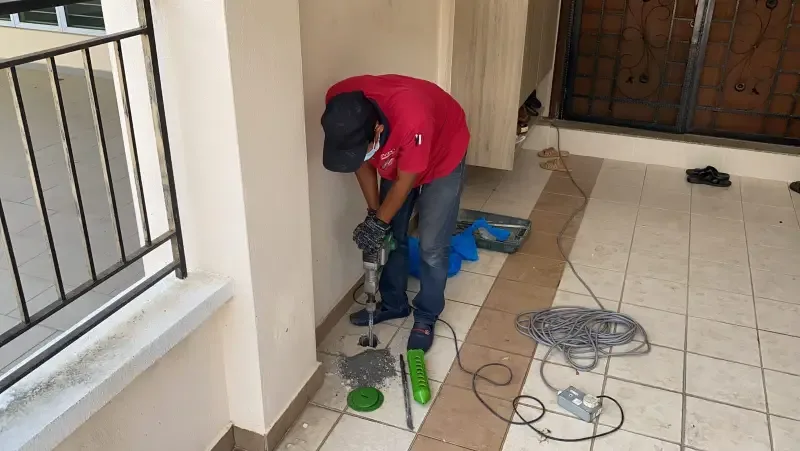
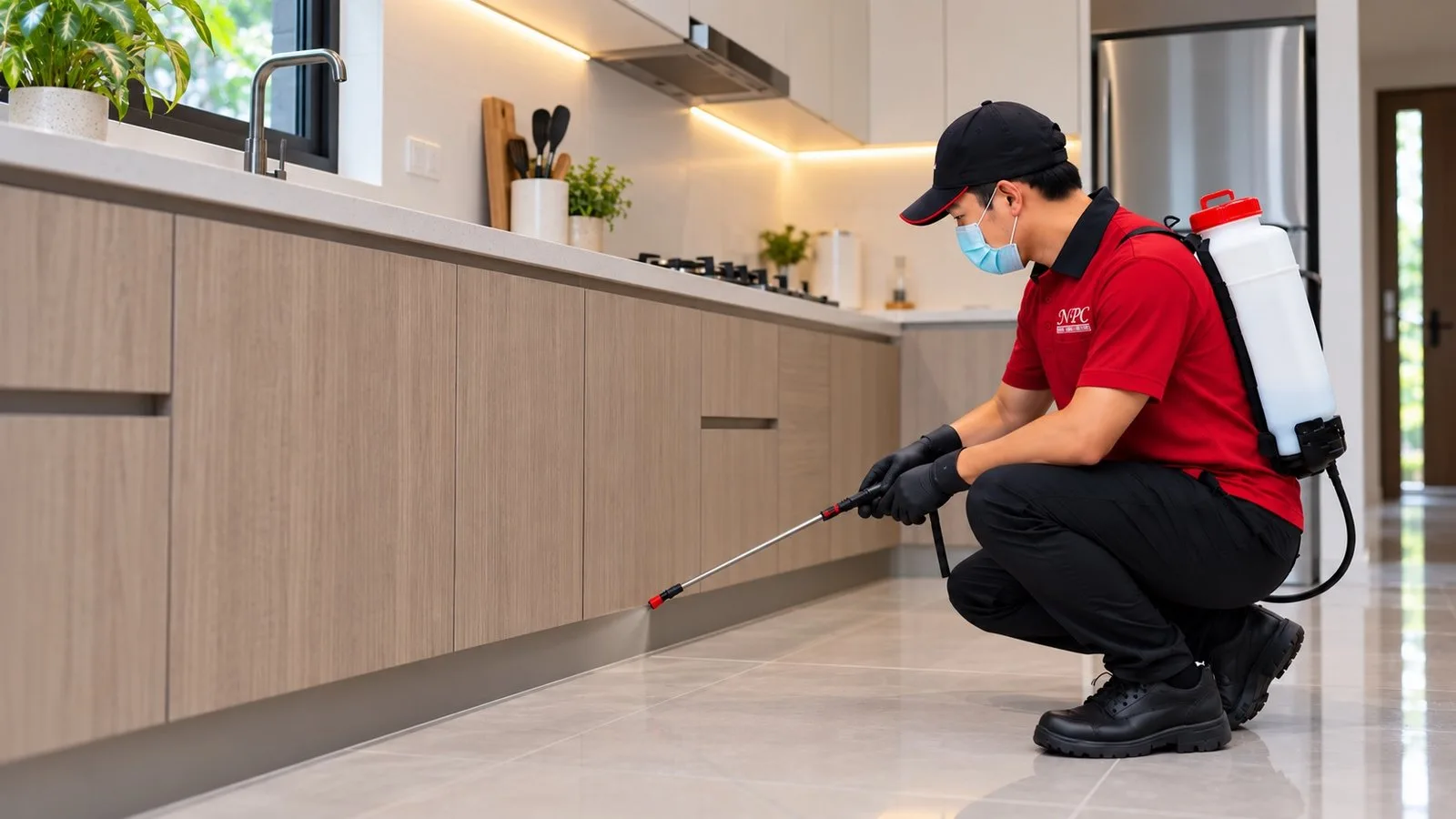
Here is a short look at NPC’s team at work.

1What Is a Wood Borer?
Quick Answer: A wood borer is a beetle whose larvae live inside wood and eat it from within for months or years. When the adult is ready, it chews a small round exit hole and flies out, leaving fine powder behind. The common household groups are powderpost beetles, false powderpost beetles and furniture beetles.
The adult beetle is small and rarely seen. The damage comes from the grubs. A female lays eggs in the pores or cracks of bare wood, and the grubs tunnel through it, turning timber into powder called frass. You only notice when adults break out.
Three groups cause most damage in homes:
- True powderpost beetles (lyctids). They attack the sapwood of hardwoods. NC State Extension describes their frass as feeling like talcum powder.
- False powderpost beetles (bostrichids). Larger holes, coarser powder. In Thailand, researchers tested treatments for rubberwood against the bostrichid Sinoxylon anale, a known pest of this timber.
- Furniture beetles (anobiids). Slow growers in older, slightly damp wood. Their frass feels gritty.
Rubberwood is widely used for Malaysian furniture, which is one reason beetle damage turns up in dining sets and bed frames. If you are dealing with termites instead, our termite control service page explains how we handle them.
2Wood Borer vs Termite Damage: How Do You Tell Them Apart?
Quick Answer: Look at what comes out of the wood. A wood borer pushes out fine, loose powder through neat round holes. Subterranean termites bring in mud and leave the surface whole. Drywood termites push out hard, grainy pellets. Mud means termites from the soil; powder with round holes usually means a wood borer.
| Sign | Borer beetle | Subterranean termite | Drywood termite |
|---|---|---|---|
| Holes on the surface | Small, neat, round exit holes | Usually none; the surface stays intact | Tiny kick-out holes, often sealed again |
| What falls out | Fine powder like flour or talc | Soil and mud, not powder | Hard, grainy pellets like ground pepper |
| Inside the wood | Winding tunnels packed with powder | Hollow galleries lined with mud, along the grain | Clean, smooth chambers across the grain |
| Mud on walls or floor | Never | Yes, mud tubes and mud patches | No |
| Where it starts | Inside the piece itself, often bare or new timber | From the soil, through walls and floors | Inside dry wood, carried in by flying adults |
| Spreads to the house? | Mostly piece by piece | Yes, a colony can reach any timber | Slowly, from piece to piece |
Source: guide by NPC Pest Control, 2026, drawing on university extension fact sheets on powderpost beetles and drywood termites.
The quickest field test is the “tap and press” check. Termite-damaged timber sounds hollow and gives way under a thumb, because termites eat it from inside and leave a thin shell. The US EPA suggests probing suspect wood with a flat screwdriver. Beetle damage also weakens wood, but it is full of loose powder, not mud.
Two more clues help:
- Mud tubes on nearby walls. These point to subterranean termites. Our guide to termite mud tubes on your wall shows how to check one.
- Damage spreading from the floor up. Termites usually enter from the ground. A beetle can be anywhere in the piece, even the top of a table.
Not sure what other early termite clues look like? Our list of white ant early warning signs covers them stage by stage.
3What Do Wood Borer Holes and Frass Look Like?
Quick Answer: Wood borer exit holes are round, clean-edged and usually between about 1 mm and 3 mm wide, depending on the beetle. Fine powder often trickles out of them or collects underneath. Subterranean termites leave no exit holes at all, and drywood termite kick-out holes are under 2 mm and often resealed.
| Insect | Largest typical hole |
|---|---|
| False powderpost beetle (bostrichid) | about 2.4 to 7.1 mm |
| Furniture beetle (anobiid) | about 1.6 to 3.2 mm |
| Drywood termite kick-out hole | under 2 mm |
| True powderpost beetle (lyctid) | about 0.8 to 1.6 mm |
| Subterranean termite | no exit holes; mud seals any gap |
Source: Iowa State University Extension (beetle exit holes, converted from inches) and UC Statewide IPM Program (drywood termite kick-out holes). Bars scaled to 7.1 mm.
The sizes above come from Iowa State University Extension, It lists exit holes of 1/32 to 1/16 inch for true powderpost beetles and up to 9/32 inch for false powderpost beetles. We converted these to millimetres.
What to look at under a torch:
- Hole shape. Beetle holes are round. Nail holes and old staples are usually square-edged or irregular.
- Powder texture. Rub it between your fingers. Flour-like or gritty powder points to beetles.
- Powder colour. Fresh frass is pale and loose. Yellow, caked frass usually means older activity.
- Location of the pile. Powder directly under a hole means something pushed it out from inside.
4Could It Be Drywood Termites Instead?
Quick Answer: It could. Drywood termites live inside dry wood without soil contact, like beetles do, so they also attack furniture. The difference is the droppings. Drywood termites push out hard pellets with six flat sides that look like ground pepper, while a wood borer leaves soft powder.
The UC Statewide IPM Program describes drywood termite pellets as having six sides and clear lengthwise ridges, and calls them diagnostic. It also lists wood-boring beetles as a common lookalike.
In Malaysian homes, subterranean termites are the bigger worry. A study in Tropical Life Sciences Research found the subterranean species Coptotermes gestroi in all nine infested buildings it examined in Penang. Compare the three:
| What you find | Most likely insect |
|---|---|
| Soft, flour-like powder | Wood borer |
| Hard, six-sided pellets | Drywood termite |
| Mud, soil or mud tubes | Subterranean termite |
A professional termite inspection settles the question when the clues are mixed.
5Which Furniture Do Wood Borers Attack in Malaysian Homes?
Quick Answer: A wood borer prefers bare, starchy sapwood, so new rubberwood furniture, rattan, bamboo and unfinished craft pieces are common targets. Subterranean termites go for anything wooden that touches or sits near the ground, such as cabinet bases, built-in wardrobes, door frames and floors. The item tells you which pest to suspect first.
| Item in a Malaysian home | Beetle risk | Subterranean termite risk |
|---|---|---|
| New rubberwood dining set or bed frame | High | Low |
| Bamboo, rattan or unfinished craft pieces | High | Low |
| Antique or old hardwood furniture | Medium | Medium |
| Plywood or chipboard cabinet on the floor | Low | High |
| Built-in wardrobe against an outer wall | Low | High |
| Door frames and skirting | Medium | High |
| Parquet or timber floor on the ground floor | Medium | High |
| Roof trusses and ceiling timber | Medium | Medium |
Source: guide by NPC Pest Control, 2026. Not measured data; a site inspection decides.
Why the split? Beetles need bare wood to lay eggs in, and the starch in young sapwood feeds the grubs. Termites need a route from the soil and some moisture, so they reach timber through walls, floors and gaps first.
Use these rules of thumb:
- Loose furniture in the middle of a room with holes and powder is most often a beetle problem.
- Fixed carpentry against a wall with soft spots and mud is most often termites.
- New furniture showing holes within months may have been infested before it reached your home.
Damp months bring other visitors too. If small, many-legged creatures turn up indoors after a storm, read our guide to millipedes in the house after rain.
Seeing pests beyond the furniture?
Our general pest control covers the wider home, from cockroaches to ants and rats. Explore our pest control services →
6How to Check If a Wood Borer Is Still Active
Quick Answer: To check if a wood borer is still active, clean away all powder, seal the existing holes with wax or wood filler, and watch for new holes and fresh powder over the following months. New holes mean live grubs inside. No change after a year usually means the damage is old.
How to check if a beetle infestation is active
Use this simple test on any piece with holes.
- Vacuum the powder. Clean the surface and the floor underneath so any new powder stands out.
- Photograph the holes. Take dated photos so you can compare later.
- Seal every hole. Fill them with coloured wax or wood filler.
- Lay dark paper underneath. Fresh pale powder shows up clearly on it.
- Check monthly. Look for unsealed new holes and new powder.
| New exit holes after plugging | Month 0 | Month 3 | Month 6 | Month 9 | Month 12 |
|---|---|---|---|---|---|
| Active beetles, no treatment | 0 | 4 | 11 | 19 | 30 |
| Active beetles, piece treated at month 0 | 0 | 2 | 3 | 3 | 3 |
| Old damage, insects already gone | 0 | 0 | 0 | 0 | 0 |
Source: illustrative scenario by NPC Pest Control, 2026, for one rubberwood table. Not measured data. A few holes can still appear soon after treatment from adults that were already close to the surface.
Iowa State Extension recommends plugging holes and checking again 6 to 12 months later, because larvae can take from a few months to several years to grow. Do not wait that long if you also see mud or soft timber; that points to termites, which need an inspection now.
7Why Wood Borer Treatment Is Different From Termite Treatment
Quick Answer: Wood borer treatment targets the grubs inside one piece, with heat, a borate product on bare wood, or by replacing the timber. Termite treatment targets a colony living in the soil, with baiting or a soil barrier. Spraying an infested table does nothing for termites, and a termite barrier does nothing for beetles in a table.
| Question | Wood borer | Subterranean termite |
|---|---|---|
| Where is the problem? | Inside the piece | A colony in the soil |
| Usual approach | Heat, borate on bare wood, or replace | Baiting or soil barrier |
| Prevention | Seal surfaces, keep wood dry | Block soil routes, fix leaks |
For beetles, Iowa State lists heating wood to about 56°C to 66°C for 30 minutes to 4 hours, and borates on unfinished wood. NC State notes that drying wood towards 13% moisture makes it less suitable. Varnish or paint blocks egg-laying on new surfaces, but it will not kill grubs already inside.
For termites, read how a termite baiting system kills colonies and how anti-termite soil treatment works. If you are unsure which pest you have, start with our pest control services and an inspection.
8What Not to Do When You Find Holes or Powder
Quick Answer: When you find holes, powder or mud, do not spray insecticide straight away, do not scrape away mud tubes, and do not move the piece next to other wooden furniture. Spraying can scatter termites and hide the evidence, while moving an infested piece can expose bare timber nearby.
- Do not spray termites. Disturbed termites retreat and move elsewhere, and the inspector loses the trail. Penn State Extension notes that termites build protected mud runways and react quickly when one is broken.
- Do not throw the piece out yet. Keep a sample of powder or pellets in a sealed bag; it helps identification.
- Do not varnish over active holes. Grubs inside keep eating and simply chew new exits.
- Do not store infested pieces in a damp storeroom. Moisture helps some beetles and invites termites.
- Do not assume new furniture is safe. Check the underside and joints of every new purchase.
If the damage is in fixed timber such as door frames, skirting or the roof, book an inspection rather than guessing. Our termite control team can confirm the source.
9Conclusion: Identify the Wood Borer or Termite First
Quick Answer: Wood borer damage shows round holes and loose powder inside one piece. Termite damage shows mud, hollow galleries and damage rising from the floor. Check the droppings, test whether the insects are active, and only then choose a treatment. When the signs are mixed or the timber is structural, get a professional inspection.
Visit the NPC Pest Control homepage to learn about our work across KL and Selangor, or see our termite control service to arrange an inspection.
10Frequently Asked Questions
1. Can wood borers spread from one piece of furniture to the whole house?
They can spread, but slowly and mostly to bare or unfinished wood nearby. Adults fly out and lay eggs in suitable timber. That is why an infested piece should be kept away from other wooden items until it is checked or treated.
2. Is wood borer damage dangerous for the house structure?
In furniture it is usually a cosmetic and strength problem for that piece. In roof timber, stairs or floors, heavy damage can weaken the wood, so a professional should check how deep it goes before anyone repairs it.
3. Will termite treatment also kill wood borers?
Not reliably. Soil barriers and termite baits target termites coming from the ground, so a beetle grub inside a table is untouched. Each pest needs its own treatment, which is why identifying the insect comes first.
4. Does NPC Pest Control offer free inspections?
Yes. NPC Pest Control is a licensed pest control operator in Puchong with over 15 years of work across Kuala Lumpur and Selangor, and inspections are free. Call 03-8061 1875 or 016-335 9799, Monday to Saturday, 9am to 6pm.
Holes, powder or mud, and not sure what it is?
Let us look at the damage, tell you whether it is termites or something else, and explain what needs to happen next in plain words.
Book a free inspection →