
Published: 7 November 2026
A night of heavy rain, and the next morning there are dark, curled-up millipedes on the kitchen floor, along the sliding door and in the bathroom. A few days later there are more. For many homes in KL and Selangor, this happens every wet season.
This guide is for homeowners, landlords and tenants who keep finding millipedes in the house. It covers:
- What millipedes are and whether they can harm your family or pets.
- Why rain drives them indoors at the same time each year in Malaysia.
- How to remove them, keep them out and know when to call a professional.
Seeing more than millipedes after the rain?
Wet weather brings ants and cockroaches too. Our general pest control covers the whole home. See our pest control services →
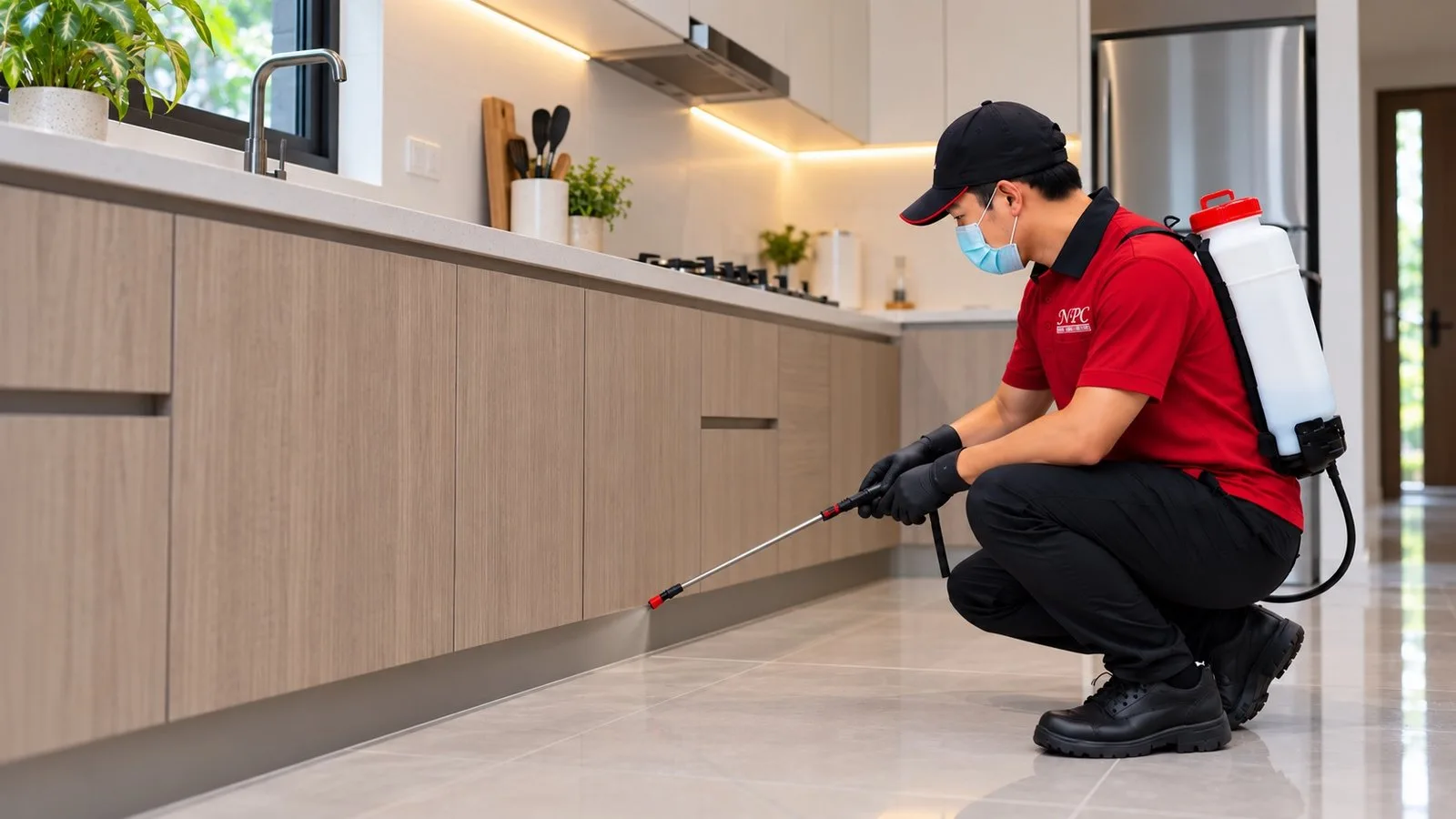
Here is a short look at NPC’s team at work.

1What Are Millipedes and Are They Harmful?
Quick Answer: Millipedes are slow, worm-like creatures with two pairs of legs on most body segments. They live in damp soil, mulch and leaf litter, where they eat rotting plant matter. They do not bite or sting, and they do not damage your house. Their only defence is a fluid that can stain or irritate skin.
Millipedes belong to a group called Diplopoda, meaning “double legs”. Colorado State University Extension notes that they feed on rotting leaves and wood and rarely touch living plants. In the garden, they recycle dead leaves.
Millipedes in the house are usually brown, black or reddish and a few centimetres long. One common type is the rusty millipede, Trigoniulus corallinus, which researchers describe as found across the world.
What millipedes do and do not do:
- They do not bite. They have no venom and no fangs.
- They curl up when touched. Penn State Extension notes they also curl into a spiral when they die, which is why you find coiled bodies.
- They leave food, wood and fabric alone. Unlike termites, they will not damage furniture. If you see holes and powder in wood, read our guide to wood borer vs termite damage.
2Why Do Millipedes Come Into the House After Rain?
Quick Answer: Millipedes come into the house after rain because heavy rain soaks the soil and leaf litter they live in. They leave flooded ground and move to higher, drier places, and walls, steps and door gaps are often the nearest. Very dry spells can trigger the same movement, because they are escaping bad conditions either way.
Millipedes need moisture, but too much water drowns them. NC State Extension explains that heavy rain pushes them out of saturated soil, and that very dry weather can also cause mass movements. Colorado State adds that invasions end as suddenly as they begin.
In Malaysia, this follows the calendar. The Malaysian Meteorological Department describes two rainfall peaks on the west coast of the Peninsula:
| Period (west coast) | Rainfall | What to expect from millipedes |
|---|---|---|
| October to November | Main peak | Most indoor sightings |
| April to May | Second peak | A second wave |
| January to February, June to July | Drier spells | Fewer, unless a dry spell ends in a big storm |
In March 2026, Bernama reported MetMalaysia’s warning that the monsoon transition from 29 March to May would bring heavy evening rain to the west and interior of the Peninsula. That is when many households start finding millipedes in the house. Our seasonal pest guide for Selangor shows which other pests follow the same rain cycle.
3Millipede or Centipede? How to Tell What Is in Your House
Quick Answer: To tell a millipede from a centipede, look at the legs and the speed. A millipede has many short legs, two pairs per segment, moves slowly and curls into a coil. A centipede has one pair of long legs per segment, runs fast and can bite. Silverfish have only six legs and silver scales.
| Clue | Millipede | Centipede | Silverfish |
|---|---|---|---|
| Legs | Two pairs on most body segments; looks like a fringe | One pair per segment; long legs that stick out | Six legs only |
| Body shape | Round or slightly flat, slow and stiff | Flat, fast, wriggles | Short, carrot-shaped, silver scales |
| When disturbed | Curls into a tight coil | Runs away fast, may bite | Darts into cracks |
| What it eats | Rotting leaves and damp wood | Other insects and spiders | Paper, glue, starch, mould |
| Harm to people | Fluid can stain and irritate skin | Painful bite, rarely serious | None to people; damages books and clothes |
| Stays indoors? | No, dies within a few days in dry rooms | Can live indoors if prey is there | Yes, breeds indoors |
Source: guide by NPC Pest Control, 2026, drawing on university extension fact sheets on millipedes and centipedes.
Getting this right matters because the advice differs. Millipedes are seasonal visitors from outside. Centipedes hunt, so seeing them indoors often means there is prey. Silverfish breed indoors, in damp, dark places with paper and starch.
A quick check for each creature:
- Touch it gently with a broom. A millipede stops and coils. A centipede sprints away.
- Look at where you found it. Millipedes cluster near doors after rain; silverfish turn up in cupboards and bookshelves all year.
- Count the days. Millipedes die off within days; one you keep finding alive for weeks is probably something else.
If it has scales and a tapered tail, read our guide to silverfish in Malaysia. Thin lines of mud running up a wall are a different problem. Learn how to check termite mud tubes on your wall.
4Where Do Millipedes Get Into Malaysian Homes?
Quick Answer: Millipedes get in at floor level, close to soil and moisture. The usual routes are the gap under the front or kitchen door, sliding door tracks, bathroom floor traps, cracks where the floor meets the wall, and potted plants brought indoors. Landed homes with gardens see the most, but low-floor condos get them too.
| Where they show up | Landed terrace | Condo, low floor | Condo, high floor |
|---|---|---|---|
| Gap under the front or kitchen door | High | Medium | Low |
| Sliding door track to the garden or balcony | High | High | Low |
| Bathroom floor trap and wet corners | High | Medium | Medium |
| Porch, car porch and wet kitchen yard | High | Low | Low |
| Cracks where the floor meets the wall | Medium | Medium | Low |
| Potted plants carried indoors | Medium | Medium | Medium |
| Lift lobby or ground-floor corridor | Low | High | Low |
Source: guide by NPC Pest Control, 2026. Not measured data; it reflects how close each spot sits to soil, plants and moisture.
Millipedes stay close to the ground. That is why a terrace house with a garden, a wet kitchen yard and a car porch gets far more millipedes in the house than a high-floor condo unit. Low-floor units next to landscaped areas sit in between.
Common hiding spots right outside the house:
- Mulch, wood chips and leaf litter along the walls and in planter boxes.
- Stacked pots, bricks and timber left on damp ground.
- Blocked drains and gutters that keep the ground wet long after the rain stops.
- Grass clippings and compost heaps, which Penn State Extension lists among their favourite cool, damp places.
These damp spots attract other pests too. A home with millipedes in the house after rain often has ant trails and cockroaches. Our guide on why DIY ant baits fail explains how ants use the same gaps.
Not sure where the pests are coming from?
We inspect the inside and outside of the house and show you the entry points. Inspections are free. Book a pest control inspection →
5Are Millipedes Dangerous to Children and Pets?
Quick Answer: Millipedes are not dangerous in the usual sense, but their defensive fluid can stain skin and cause a burning feeling, blisters or dark marks that fade over weeks. The real risk is to the eyes, and young children are most often affected. Wash contact areas with soap and water and see a doctor if fluid reaches an eye.
| Finding | Share of the 8 cases |
|---|---|
| Seen in the rainy season | 8 of 8 cases |
| Burn on the skin around the eye | 8 of 8 cases |
| Patient was a child (9 months to 7 years) | 7 of 8 cases |
| Marked swelling around the eye | 3 of 8 cases |
| Conjunctivitis (red, irritated eye) | 2 of 8 cases |
| Keratitis (inflamed cornea) | 1 of 8 cases |
| Lasting loss of sight | 0 of 8 cases; all recovered |
Source: Transactions of the Royal Society of Tropical Medicine and Hygiene, 1997 (PubMed 9196764), Madang General Hospital, Papua New Guinea. The 8 cases were 0.06% of 14,000 eye patients in the same period.
Large tropical millipedes release a fluid that often contains benzoquinone. A 2015 case report in the Journal of Dermatological Case Reports notes the fluid can leave black, brown, red or purple marks; in that case the mark faded within three months.
The eye study above comes from a hospital in Papua New Guinea, where giant millipedes are common. Eye burns were rare, but every case came in the rainy season, nearly all were small children, and all recovered.
Simple precautions at home:
- Keep toddlers from picking them up. Children touch them, then rub their eyes.
- Pick them up with a broom or tissue.
- Wash with soap and water straight after any contact.
- Watch your pets. NC State Extension notes they are not dangerous to animals unless eaten in large amounts, and most pets avoid them because of the smell.
6How to Get Rid of Millipedes in the House
Quick Answer: To get rid of millipedes in the house, sweep or vacuum the ones you can see, then fix the damp conditions outside that are producing them. Spraying indoors does little, because the millipedes indoors are already dying. Seal door gaps, clear mulch and leaf litter from the walls, and keep drains flowing.
Both Colorado State and NC State Extension say the same thing: millipedes in the house usually die within a day or two because indoor air is too dry, and drying out moist areas outside is usually enough.
How to get rid of millipedes after heavy rain
Do this the morning after a storm.
- Sweep or vacuum them up. Empty the bag or dustpan outside.
- Wipe the floor. Use soap and water to remove any fluid.
- Find the entry point. The bodies usually cluster near the door, track or floor trap they used.
- Block the gap. Fit a door sweep, seal floor-wall cracks and keep floor trap covers in place.
- Clear the strip outside. Rake mulch, leaves and clutter away from the outside wall.
- Clear drains and gutters. Let the ground near the house dry out faster after rain.
Colorado State mentions an insecticide treatment around the base of the building only if problems continue, and that is a job for a licensed operator. Our guide to what pest control services include explains what a proper visit covers.
7How to Keep Millipedes Out for Good
Quick Answer: To keep millipedes out, make the ground next to your house dry and bare. Pull mulch and leaf litter back from the walls, lift pots and stacked items off the soil, clear drains and gutters, and seal gaps under doors and around sliding tracks. Do this before the October and April rain peaks.
| Millipedes found indoors per day | Day 1 | Day 2 | Day 3 | Day 5 | Day 7 | Day 10 |
|---|---|---|---|---|---|---|
| No changes made | 6 | 14 | 18 | 11 | 6 | 2 |
| Doors sealed only | 3 | 6 | 7 | 4 | 2 | 1 |
| Doors sealed, mulch and leaf litter cleared, drains cleaned | 2 | 3 | 2 | 1 | 0 | 0 |
Source: illustrative scenario by NPC Pest Control, 2026, for one landed terrace house with a garden. Not measured data.
The pattern above is illustrative, but it follows the extension advice. Sealing doors helps. Removing the damp habitat next to the wall helps far more, because fewer millipedes live there.
A pre-monsoon checklist for landed homes:
- Clear a dry band along the walls. Keep mulch and plants back from the base of the house.
- Remove weed barriers that trap moisture. Penn State Extension notes that removing them lowers soil moisture and raises temperature, which millipedes dislike.
- Fit door sweeps on doors that open to the garden, yard or porch.
- Fix leaking taps and aircon drain pipes that keep soil wet.
- Store timber and bricks off the ground. Damp timber against a wall also attracts termites.
In condos, the fixes are smaller: door sweeps, floor trap covers and balcony plants kept off the floor. If millipedes in your house come from the common garden, raise it with the management office.
Dry soil also helps against termites. Our termite control service page explains how we protect homes from the ground up.
8When Should You Call Pest Control for Millipedes?
Quick Answer: Call pest control when millipedes in the house keep coming back every storm despite clearing the outside, when you are finding hundreds, or when you see other pests in the same damp spots. A professional can find the source, treat the outside where needed, and check for termites, ants or cockroaches using the same routes.
Most cases of millipedes in the house are solved with the steps above. A visit makes sense when you see:
- Large numbers every time it rains, even after clearing mulch and sealing doors.
- A garden you cannot change, such as a shared landscaped area or a slope.
- Other pests at the same spots, such as cockroaches at floor traps or mud tubes on walls.
A general pest control visit covers the whole home. Read about our pest control services, or see how cockroach control works if roaches share the same drains. Our Selangor pest control pricing guide explains the usual rates.
9Conclusion: Fix the Ground Outside First
Quick Answer: Millipedes in the house after rain are escaping waterlogged soil. They are harmless to the building, mildly irritating to skin, and most die within days. Sweep them up, keep their fluid away from eyes, then dry out the ground along your walls and seal the gaps before the next rain peak.
Visit the NPC Pest Control homepage to learn about our work across KL and Selangor, or see our pest control services to arrange an inspection.
10Frequently Asked Questions
1. Do millipedes bite or sting?
No. Millipedes have no venom and do not bite people. Their only defence is to curl up and release a fluid that can stain and irritate skin. Wash any contact area with soap and water, and keep the fluid away from the eyes.
2. Why do I find dead, curled-up millipedes on the floor in the morning?
They came in overnight after rain and dried out, because indoor air is too dry for them. Sweep them up, then look for the gap they used.
3. Do millipedes breed inside the house?
Rarely. They lay eggs in damp soil, mulch and leaf litter outdoors. Seeing many indoors usually means a large population lives right outside, so that is where the fix belongs.
4. Does NPC Pest Control offer free inspections?
Yes. NPC Pest Control is a licensed pest control operator in Puchong with over 15 years of work across Kuala Lumpur and Selangor, and inspections are free. Call 03-8061 1875 or 016-335 9799, Monday to Saturday, 9am to 6pm.
Millipedes every time it rains?
We find where they come from, check for other pests in the same damp spots, and tell you plainly what is worth doing.
Book a free inspection →