
Published: 9 November 2026
You switch on the bathroom light at night and a small, shiny grey insect darts behind the sink. Later you find tiny holes in an old photo album, or yellow marks on a shirt that has sat in the wardrobe for months. Silverfish are behind both.
This guide is for homeowners, landlords and tenants in KL and Selangor. It covers:
- How to identify these insects and tell them apart from similar pests.
- Why Malaysian homes suit them and where they hide.
- What works to remove them, which home remedies fall short, and when to call a professional.
Finding more than one kind of crawling insect?
Damp rooms often hold cockroaches and ants too. Our general pest control covers the whole home. See our pest control services →
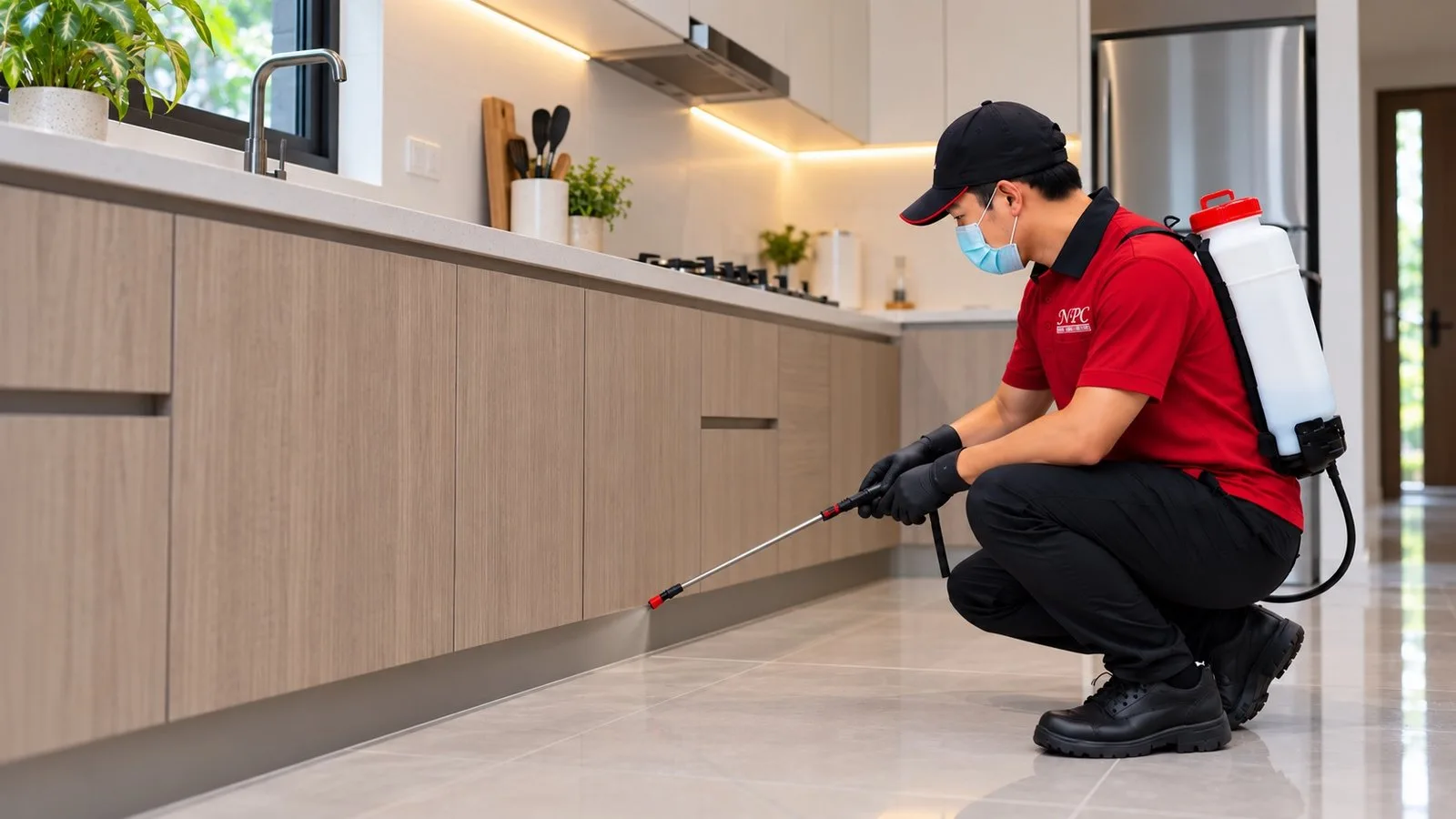
Here is a short look at NPC’s team at work.

1What Are Silverfish and How Do You Identify Them?
Quick Answer: Silverfish are small, wingless insects about 12 to 19 mm long, with a flat, carrot-shaped body covered in silver or grey scales. They have two long antennae at the front and three thin tails at the back. They move fast, wriggle like a fish, and are most active at night.
These are some of the oldest insects on earth. The UC Statewide IPM Program describes the common species, Lepisma saccharina, as shiny silver or pearl grey and about half an inch long. A 2024 review in the Journal of Insect Science lists nine species that live alongside people worldwide, spread mainly by moving goods and people.
Three you may meet indoors:
- Common silverfish. Silver, shiny, likes cool damp rooms such as bathrooms.
- Long-tailed or grey silverfish. Greyer, with longer tails. It has spread fast in Europe and is harder to control.
- Firebrat. Brown and mottled. NC State Extension notes it prefers hot spots near stoves and roof spaces.
Something slow that curls into a coil after rain is a millipede. Read our guide on millipedes in the house after rain to tell the two apart.
2Why Do Silverfish Appear in Malaysian Homes?
Quick Answer: Silverfish appear in Malaysian homes because the air stays humid all year. They need high humidity to survive, and bathrooms, storerooms and closed rooms give them that. Add paper, cardboard and starch to eat and dark gaps to hide in, and a few can grow into a steady population.
Humidity is the main driver. The UC IPM fact sheet says they need relative humidity above 75% at warmer temperatures. The Malaysian Meteorological Department describes high humidity across the year, peaking around November.
| Need | What they need | Typical Malaysian home | What to change |
|---|---|---|---|
| Humidity | Above 75% relative humidity at warm temperatures | Humid all year; bathrooms and closed rooms stay damp | Run the aircon or a dehumidifier; air out closed rooms |
| Temperature | About 22°C to 32°C | Indoor rooms sit in this range most of the year | Little to change; focus on humidity instead |
| Food | Starch, glue, paper, flour, cereals, pet food | Boxes, old books, wallpaper paste, rice and cereal packets | Seal dry food; clear old paper and boxes |
| Shelter | Dark, undisturbed cracks | Storerooms, cabinet backs, ceiling voids, tile gaps | Seal cracks; declutter so spots get disturbed |
| Time without food | Several months | Empty units and stored boxes can hold them | Check boxes before unpacking |
Source: guide by NPC Pest Control, 2026. Needs from the UC Statewide IPM Program fact sheet (humidity above 75%, 71–90°F, months without food).
What usually tips a home over:
- Rooms that stay shut. Spare rooms and storerooms with no airflow stay damp.
- Bathrooms that never dry. No exhaust fan, wet mats and leaking pipes keep the air moist.
- Cardboard boxes. They carry the insects in from storage and give them food and shelter.
- Long holidays. With the aircon off, humidity climbs. They can also live for months without food.
The rainy months make things worse. Our Selangor seasonal pest guide shows which other pests rise with the same weather.
3Where Do Silverfish Hide in the House?
Quick Answer: They hide in dark, damp, undisturbed places close to paper or starch. Check bathroom gaps behind the sink and toilet, storerooms full of cardboard boxes, bookshelves, wardrobes and kitchen cabinets. Ceiling voids and cracks behind loose tiles or skirting are common too. Older buildings with more cracks see the most.
| Spot in the home | Landed terrace | Condo unit | Older walk-up or shophouse |
|---|---|---|---|
| Bathroom, behind the sink and toilet | High | High | High |
| Storeroom with cardboard boxes | High | Medium | High |
| Bookshelf and document files | Medium | Medium | High |
| Wardrobe with rarely worn clothes | Medium | Medium | Medium |
| Kitchen cabinet and dry food shelf | Medium | Medium | High |
| Ceiling void and roof space | Medium | Low | High |
| Gaps behind skirting and loose tiles | Medium | Low | High |
Source: guide by NPC Pest Control, 2026. Not measured data; it reflects damp, darkness and paper or starch at each spot.
They come out at night and run for cover when the light goes on, so most people see only a few. NC State Extension lists cast skins, scales and droppings as signs to look for.
How to find where they live:
- Set sticky traps in corners of the bathroom, storeroom and wardrobe for a week.
- Check after dark with a torch along skirting, sink cabinets and shelf backs.
- Look for droppings like tiny black pepper grains and fine silver scales on shelves.
Cockroaches use many of the same damp spots. If you see both, our cockroach control guide explains how gel baits and sprays are used.
4What Do Silverfish Eat and What Damage Do They Cause?
Quick Answer: Silverfish eat starch, sugar and protein. That means paper with glue, book bindings, wallpaper paste, photos, cardboard, starched clothes, flour, cereals and pet food. They scrape at surfaces instead of biting through them, leaving irregular holes, notched edges, thin patches and yellowish stains. They do not damage wood or the structure of your home.
The UC IPM fact sheet notes they scrape the surface of paper, leaving unconnected, irregular holes. NC State adds ragged edges on book bindings.
| What you find | Likely cause |
|---|---|
| Thin patches and ragged holes in paper or photos | Silverfish |
| Small round holes and fine powder in furniture | Wood borer beetles |
| Hollow timber, mud lines on walls | Termites |
If wood is involved, the pest is something else. See our guide to wood borer vs termite damage, and learn to check termite mud tubes on your wall. Termites need fast action through termite control.
5Are Silverfish Harmful to People and Pets?
Quick Answer: These insects are not harmful to people or pets in any direct way. They do not bite, sting or spread disease. The harm is to your things: books, documents, photos, wallpaper and stored clothes. Their shed skins and scales add to household dust, which may bother people with dust allergies.
The bigger concern is slow, hidden damage. Valuable documents, certificates and family photos stored in boxes are at the most risk. A 2025 review in PeerJ groups them with the main insect threats to paper in homes and heritage buildings.
- Move important papers into sealed plastic boxes.
- Keep pet food sealed overnight.
- Wash stored clothes before packing them away.
Want a second pair of eyes on your storeroom?
We check damp corners for crawling insects and termites in one visit. Inspections are free. Book a pest control inspection →
6Do Home Remedies for Silverfish Work?
Quick Answer: Some home remedies help, but none fix the cause alone. Sticky traps show where they are but rarely clear a population. Spraying kills the ones you hit and misses the rest. Diatomaceous earth and boric acid can work in dry cracks. Research on the long-tailed species found poisoned bait beat both traps and sprays.
| Bait and route | Share killed in lab tests |
|---|---|
| Indoxacarb bait, eaten directly | More than 90% killed |
| Clothianidin bait, eaten directly | More than 90% killed |
| Fipronil bait, eaten directly | More than 90% killed |
| Indoxacarb, passed on by eating poisoned dead insects | More than 75% killed |
| Clothianidin or fipronil, passed on the same way | Not high; only indoxacarb gave high kill this way |
Source: Insects, 2020 (PubMed 32156066), Norway. Baits were offered alongside normal food. Field-aged indoxacarb bait still killed for more than 6 months.
A field study in Insects (2020) found small indoxacarb bait droplets along walls outperformed sticky-trap mass trapping and conventional spray in apartments. A follow-up in PLoS One (2021) found bait worked better when spread evenly along every edge, left in place longer, and paired with removing other food.
| Remedy | Verdict |
|---|---|
| Sticky traps | Good for finding them; weak for clearing them |
| Insect spray | Kills on contact only; numbers bounce back |
| Diatomaceous earth, boric acid | Helps in dry cracks; keep away from children and pets |
| Cloves, cedar, essential oils | May repel briefly; no solid evidence of control |
Ants show the same pattern with sprays. Our article on why DIY ant baits fail explains it.
7How to Get Rid of Silverfish at Home
Quick Answer: To get rid of silverfish, make the room too dry and too bare for them. Lower the humidity, clear out cardboard and old paper, seal cracks and gaps, and store food and documents in sealed containers. Then monitor with sticky traps. Most homes see numbers fall over several weeks.
How to get rid of silverfish in a room
Work through one room at a time, starting with the one where traps catch the most.
- Dry the air. Run the aircon, a dehumidifier or an exhaust fan, and open the room to airflow each day.
- Fix leaks. Repair dripping pipes and wet patches under sinks.
- Clear cardboard and old paper. Move stored items into sealed plastic boxes.
- Vacuum edges and shelves. Remove eggs, scales and crumbs from cracks and corners.
- Seal gaps. Fill cracks around skirting, pipes and loose tiles.
- Monitor for eight weeks. Keep sticky traps in place and count the catch each week.
| Caught on 6 sticky traps per week | Week 1 | Week 2 | Week 4 | Week 6 | Week 8 | Week 12 |
|---|---|---|---|---|---|---|
| Spray when seen | 24 | 15 | 20 | 22 | 18 | 23 |
| Dry the room and declutter | 24 | 20 | 14 | 10 | 8 | 6 |
| Dry, declutter and bait along edges | 24 | 18 | 9 | 4 | 2 | 1 |
Source: illustrative scenario by NPC Pest Control, 2026, for one 3-bedroom condo unit. Not measured data; the pattern follows field studies where bait beat sprays and sticky traps.
The numbers above are illustrative, but they follow the research: drying and decluttering cut numbers steadily, and bait along edges speeds it up. Eggs take about 19 to 32 days to hatch, according to UC IPM, so expect new young ones for a month or more after you start.
8When Should You Call Pest Control for Silverfish?
Quick Answer: Call pest control when they keep turning up after weeks of drying and decluttering. Damage to documents or books you value, or other pests in the same damp spots, are also good reasons. A licensed operator can confirm the species, find hidden harbourage and treat cracks with registered products.
A visit makes sense when:
- Trap counts stay high after eight weeks of home fixes.
- The source is hard to reach, such as a ceiling void or wall cavity.
- Other pests share the same spots, such as cockroaches in the bathroom or termites near damp timber.
A general visit covers the whole home. Our guide to what pest control services include explains a typical visit, and the Selangor pest control pricing guide sets out usual rates. To compare providers, see our checklist for choosing a pest control company.
9Conclusion: Dry Air Is Your Best Defence
Quick Answer: Silverfish in Malaysia come down to humid air, hidden gaps and paper or starch to eat. They do not bite and do not harm the building, but they slowly ruin books, photos and clothes. Dry the air, clear the clutter, seal the gaps and monitor with traps.
Visit the NPC Pest Control homepage to learn about our work across KL and Selangor, or see our pest control services to arrange an inspection.
10Frequently Asked Questions
1. Do silverfish bite?
No. They have no sting and do not bite people or pets. They scrape at paper, glue and fabric. The harm is to books, photos, wallpaper and stored clothes, plus the nuisance of finding them in the bathroom.
2. Does seeing one silverfish mean an infestation?
Not always. One may have come in with a box or bag. Set two or three sticky traps in the room for a week. If you keep catching them, a population is living nearby, usually in a damp, undisturbed spot.
3. Do silverfish mean my house is dirty?
No. Clean homes get them too. They follow humidity, darkness and paper or starch. A spotless bathroom with poor airflow can still suit them well.
4. Does NPC Pest Control offer free inspections?
Yes. NPC Pest Control is a licensed pest control operator in Puchong with over 15 years of work across Kuala Lumpur and Selangor, and inspections are free. Call 03-8061 1875 or 016-335 9799, Monday to Saturday, 9am to 6pm.
Still finding silverfish after drying things out?
We check where they are living, look for other pests in the same damp spots, and tell you plainly what is worth doing.
Book a free inspection →