Last updated: 23 September 2026
1Why Does the Building Matter More Than the Address Here?
Quick Answer: Because almost nobody here has a building to themselves. A shoplot row shares a ceiling void, a party wall, a drain run and a bin point, so a problem that starts two doors down arrives at your unit without ever going outside. Pest control services in Seri Kembangan have to treat the stack, not the unit.
In a detached house you can usually find the source on your own property. In a shoplot row, it is often on a floor you have never been to, behind a wall you do not own.
- The ceiling void is one space. Party walls usually stop at the ceiling line, so the void above runs the whole row. Rats use it as a corridor.
- The drain line is shared. Your floor trap, the kitchen below and the unit at the end of the row sit on one run.
- Uses are stacked, not separated. Food below, people above, storage between. Each feeds a different pest in one building.
- Nobody owns the middle. The riser, void and back lane belong to everyone, which means nobody inspects them.
Our guide to what pest control services include in 2026 covers what a standard visit involves.
Not sure whether the problem started in your unit?
A free inspection traces the population back to where it sits, which decides whether you need a treatment or a conversation with management. See the pest control services we inspect for →
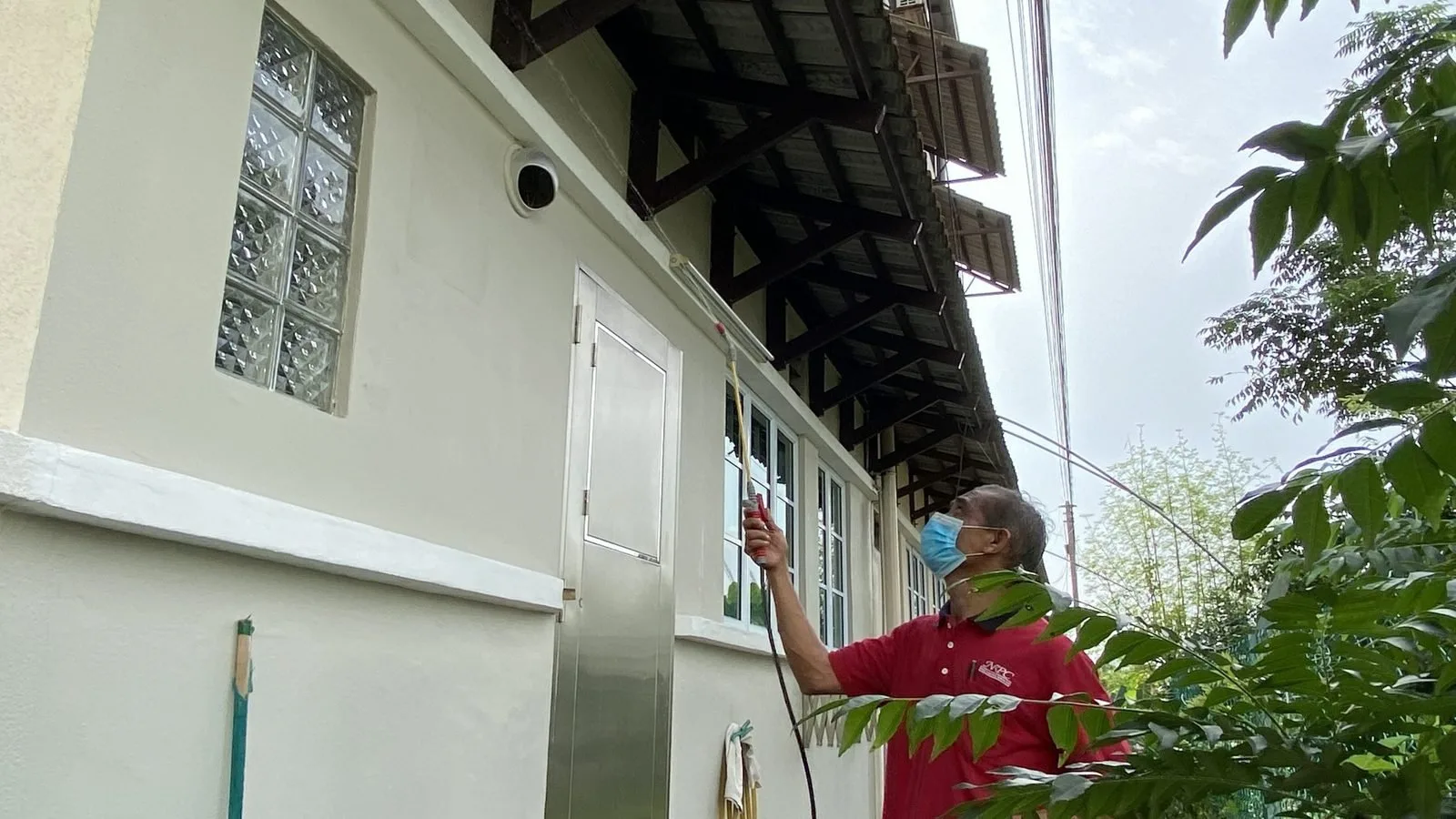
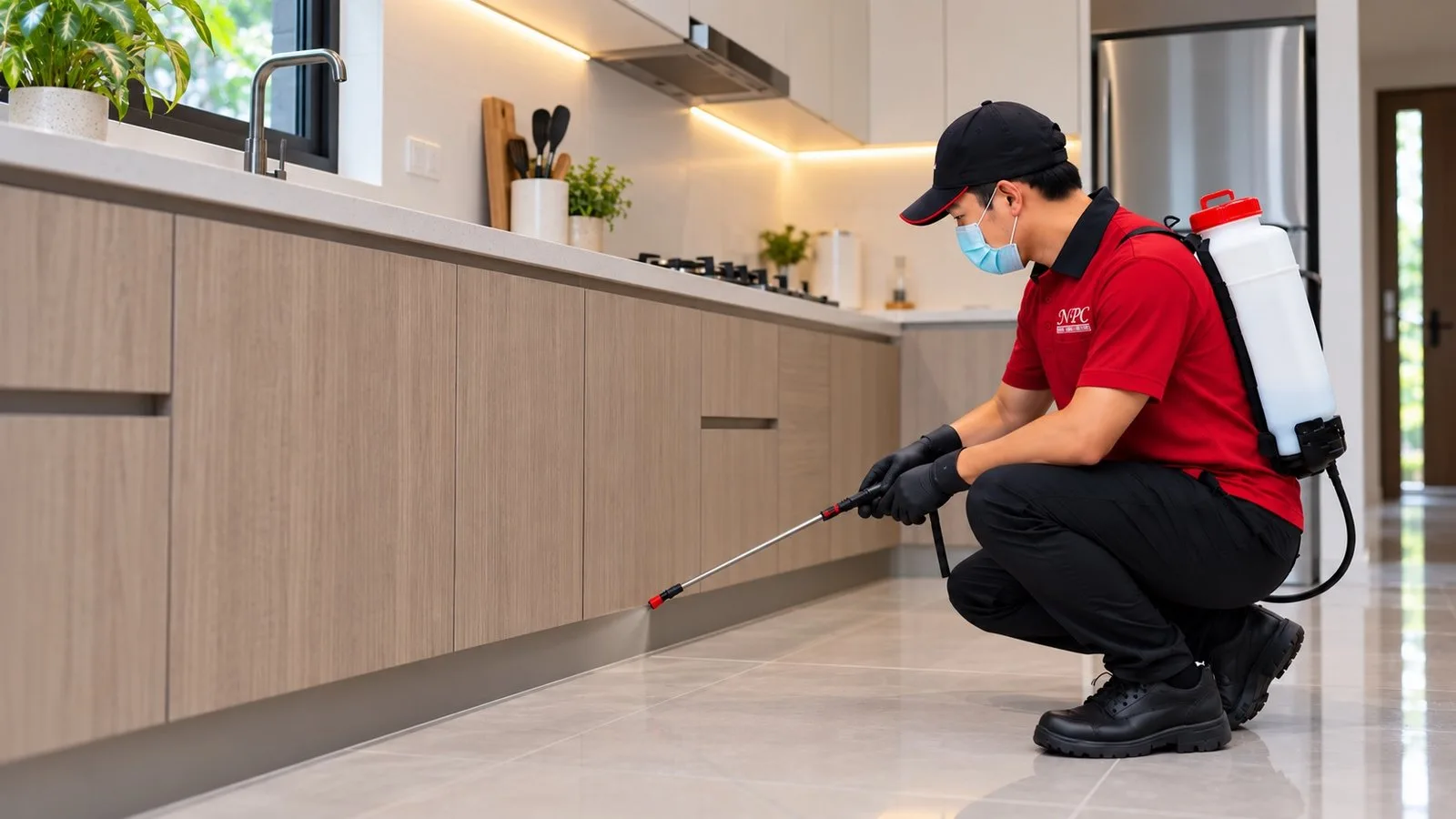
A short look at our licensed team at work.

2Where Does the Source Usually Sit?
Quick Answer: Outside your own four walls, most of the time. The shared drain line and floor traps are the most common true source, then the ceiling void, then the unit directly below you. Pest control services in Seri Kembangan open those three before accepting that a problem is self-contained.
| How often the source is outside your unit | Where it actually sits | Why it reaches you |
|---|---|---|
| Nearly always | Shared drain line and floor traps | One broken trap feeds every unit on the run. |
| Usually | The ceiling void above your ceiling | Open above the party wall, so it runs the whole row. |
| Often | The unit directly below you | Kitchens push everything upward through gaps and risers. |
| Sometimes | The shared bin area and back lane | Feeds the whole block, not the unit reporting it. |
| Rarely | Your own unit, on its own | A self-contained problem is the exception in a shoplot row. |
Source: illustrative guide by NPC Pest Control, 2026. Not measured data.
The ratings are illustrative, drawn from our own jobs, but the order holds up across sites.
- A broken floor trap is the loudest signal on the property. It opens straight into a pipe run that reaches every unit sharing it, and costs almost nothing to fix.
- Things travel upward more than downward. Warm air, cooking smells and grease rise through the gaps around pipes, and cockroaches follow.
3What Does the Research Say About Pests Moving Between Units?
Quick Answer: That they move within a building far more than between buildings. A twelve-month study of a 188-unit block found the one link still showing after building-wide treatment was between floors. A genetic study found cockroaches in one building more closely related than those next door.
| What was studied | What it found | Why it matters in a shared building |
|---|---|---|
| 188-unit block, a year of building-wide treatment | After twelve months, the one link still showing was the one between floors. | The stack, not the unit, is what gets treated. |
| 18 apartments, six complexes, genetic study | Cockroaches within one building were more closely related than those in the block next door. | They walk between units, not between buildings. |
| Bin chamber and sanitary pipework, apartment block | Rodent activity was 36.7 times likelier where a floor trap was broken, 12.3 times where the pipe below was defective. | The pipe run is a road; a broken trap is the door. |
| American cockroaches in a campus sewer, Malaysia | Gel bait inside manholes cut adults 91.17% and nymphs 85.50%, holding eight weeks. | Treating the shared drain works. |
| 29 apartments, six-month trial of unit-level treatment | Counts fell 99% with baits, dust and traps, against 51% untreated. | One unit can be cleared. It does not stay clear alone. |
Sources: Journal of Economic Entomology 2019; Journal of Medical Entomology 2010; Infection Ecology & Epidemiology 2022; Heliyon 2023; Insects 2026.
The building-wide finding comes from a 2019 study in the Journal of Economic Entomology, which mapped German cockroach infestations through a 188-unit high-rise before and after a year of building-wide treatment. Infestations were spatially correlated at the start. Twelve months on, the correlation that survived was the one across floors — the last connection to break.
A 2010 study in the Journal of Medical Entomology asked the same question genetically, across 18 apartments in six complexes. Cockroaches within one building were more closely related to each other than to those in a separate block on the same site. They walk between units, rarely between buildings.
4Which Pest Starts Where in the Stack?
Quick Answer: Cockroaches and rats start at the ground-floor kitchen and the shared drain. Bed bugs start in the rented rooms upstairs. Rats and termites own the ceiling void. Pest control services in Seri Kembangan use the position in the building to predict the pest list, because it does that better than the business type does.
| Where in the stack | Cockroaches | Rats | Termites | Bed bugs | Mosquitoes |
|---|---|---|---|---|---|
| Ground-floor kitchen or food shop | High | High | Low | Low | Low |
| First-floor office, clinic or tuition centre | Medium | Medium | Medium | Low | Low |
| Upper-floor flat or room rental | Medium | Medium | Medium | High | Medium |
| Ceiling void running along the row | Medium | High | High | Low | Low |
| Shared drain line and floor traps | High | High | Low | Low | Medium |
| Back lane bin point, roof tank | Medium | High | Low | Low | High |
Source: illustrative guide by NPC Pest Control, 2026. Not measured data.
Find your row. When we plan pest control services in Seri Kembangan, a tuition centre and a small office on the same floor behave almost identically.
- The ground floor sets the tone for everyone above it. A kitchen down there puts the whole stack on a cockroach and rat plan. Our cockroach control page covers that.
- Rented rooms are the bed bug entry point. People and luggage bring them in, not the building. Our guide to homes and student rentals in Serdang covers that pattern.
- The void carries the rats along the row. Our rat control page covers the proofing and baiting that closes it, and pest control services in Seri Kembangan should always ask to get into it.
Running a shop, kitchen or office in a shared row?
We inspect the whole run — your unit, the void above and the drain below — and report by unit, so everyone sees which part carries the problem. See how commercial pest control works →
5How Do You Tell Whose Problem It Is?
Quick Answer: Follow the trail rather than the sightings. Check your floor traps first, then the pipe penetrations and the ceiling access, then compare what you find with the units either side. Fifteen minutes with a torch tells pest control services in Seri Kembangan more than a month of counting cockroaches in your kitchen.
Sightings tell you where a pest feeds. They rarely tell you where it lives, and the two are often on different floors.
How to work out whether the source is in your unit or someone else’s
Take a torch and fifteen minutes. Look for openings, droppings and grease trails, not for the pests themselves.
- Lift every floor trap and look at the seal. A dry, cracked or missing trap is an open pipe, and our most common finding.
- Check where pipes pass through walls and slabs. That gap is rarely sealed properly, and it joins you to the units above and below.
- Open the ceiling access and shine the torch sideways. Droppings, rub marks and gnawed insulation mean the void is being used as a corridor.
- Look behind and under the fridge and stove. Numbers concentrate there, so they show you scale rather than source.
- Walk the back lane and look at the bin point. If it serves the whole row, the row has to fix it together.
- Ask the units either side what they are seeing. If three units report the same thing in the same month, the source is between you.
Write down what you find and when. It is the difference between a conversation with management that goes somewhere and one that does not.
6What Happens If Only One Unit Gets Treated?
Quick Answer: It works for about a month, then it undoes itself. Numbers drop sharply, the neighbours stay untreated, and the population walks back along the same drain and void it used the first time. Pest control services in Seri Kembangan see this cycle constantly in shoplot rows where only the complainer pays.
| What is counted | Month 0 | Month 1 | Month 3 | Month 6 | Month 9 | Month 12 |
|---|---|---|---|---|---|---|
| Cockroaches per trap, unit treated alone | 40 | 6 | 11 | 22 | 31 | 38 |
| Cockroaches per trap, whole stack treated | 40 | 5 | 3 | 2 | 2 | 1 |
| Units still reporting sightings, unit alone | 4 | 3 | 4 | 5 | 5 | 6 |
| Units still reporting sightings, whole stack | 4 | 2 | 1 | 1 | 0 | 0 |
Source: illustrative model by NPC Pest Control, 2026, one Seri Kembangan shoplot row.
The model is illustrative, but the shape is the part to remember. The first month always looks like a success.
- The rebound is not a treatment failure. The product worked; the scope left out where the population lived.
- Cost-sharing beats repeat visits. Six units splitting one proper job usually pay less each than one unit paying for four failed rounds.
A 2026 trial published in Insects shows the other half of the picture: across 29 apartments, units given baits, dust, traps and proper instruction saw counts fall 99% over six months against 51% in untreated units, and cockroaches became undetectable in 58% of them. A unit can be cleared properly. It just does not stay clear alone.
7What About the Drain, the Bin Point and the Back Lane?
Quick Answer: They are the shared half of the job and almost always the neglected half. The drain run carries cockroaches between units, the bin point feeds the rats, and the back lane connects both to the rest of the row. Pest control services in Seri Kembangan treat these as part of the building, not as somebody else’s ground.
The evidence says the shared parts are where one job does the most good, and that treating them works.
- The pipework is a measured risk. A 2022 study in Infection Ecology & Epidemiology tracked rodents through an apartment block’s sanitary waste network and found activity 36.7 times likelier where a floor trap was broken, and 12.3 times likelier where the pipe under the bin chamber was defective.
- Baiting the drain itself works. A 2023 Malaysian study in Heliyon put imidacloprid gel bait inside manholes and cut American cockroach adults 91.17% and nymphs 85.50%, holding eight weeks.
- The bin point is the rat’s reason to stay. Our guide to sealing the gaps rats use covers the proofing that ends it at your wall.
If you run a kitchen, our restaurant pest control page covers the records inspectors ask for. For how a freight-led corridor compares, see our Klang guide.
8What Should You Ask a Company Before You Book?
Quick Answer: Ask what they will do outside your unit. Any firm offering pest control services in Seri Kembangan should hold a valid operator licence, inspect the floor traps, ceiling void and drain run as well as your rooms, and hand you a written report naming product, concentration and every area treated.
The question that separates a firm that understands shared buildings from one that does not: will they open the ceiling and the floor traps, or only spray the skirting? Also verify:
- A valid operator licence. Pest control is licensed work in Malaysia, and termite treatment needs a licensed applicator on site.
- A written service report every visit. Product, concentration, method, area and quantity, in a form a landlord or auditor accepts.
- Willingness to quote the row, not just you. A firm that will price a shared job understands where the population lives.
- Monitoring that stays in place. Traps and bait points left behind show the return in week one, not month six.
Our checklist for choosing a pest control company sets out eight things worth verifying, and our guide to common pests by area in Kuala Lumpur shows how a firm should adapt between districts.
9Conclusion: Treat the Stack, Not the Unit
Quick Answer: Work out what is above you, what is below you and what runs between you, and most of the problem explains itself. Pest control services in Seri Kembangan hold when the floor traps, the void and the drain run are in the plan alongside your own rooms.
The short version: open the floor traps, seal the pipe gaps, get into the ceiling void, deal with the bin point as a row, and ask how far outside your unit a quote reaches.
For more, visit the NPC Pest Control homepage or our pest control services hub, or go straight to cockroach control, rat control and termite control.
10Frequently Asked Questions
1. How much do pest control services in Seri Kembangan cost?
The building type moves the price more than the address does. As an indication of Klang Valley market ranges, a one-off treatment for a terrace house or flat sits in the low hundreds of ringgit, while a shoplot with a kitchen below and tenants above is quoted on the number of units and the length of the shared drain run.
2. My neighbour will not treat their unit. What can I do?
Treat it as containment rather than a cure. Close the floor traps, seal the riser and pipe penetrations, and keep monitoring in place so you see the return early. Then raise it with the management, because the shared drain and ceiling void are usually their responsibility, not yours.
3. Why do the cockroaches come back a few months after treatment?
Because the treatment reached your unit and not the run the population lives in. Research in a 188-unit block found the one connection still showing after a year of building-wide work was the one between floors. If the stack is not in the plan, your unit is just the first to get clean.
4. I live in a landed house here, not a shoplot. Does any of this apply?
Some of it. Your drain line still connects to your neighbours’, and a broken floor trap is still the biggest rodent risk on the property. Termites, though, come from the soil under your own house.
5. How do I book pest control services in Seri Kembangan?
Call NPC Pest Control on 03-8061 1875 or 016-335 9799, Monday to Saturday, 9am to 6pm. We are a licensed operator in Bandar Puteri Puchong with over 15 years across KL and Selangor. Inspections are free.
Find out whose floor the problem is really on
We inspect free across Seri Kembangan, from shoplot rows and flats to landed housing, and you get a written report naming where the population sits, who controls that space and what the treatment reaches.
Book a free inspection →