Last updated: 22 September 2026
1Which Commercial Fly Trap Does Your Business Need?
Quick Answer: Most Malaysian food businesses need a UV glue board trap for kitchens and stores, a decorative glue board unit for dining areas, and a zapper only for outdoor or bin areas. The right commercial fly trap in Malaysia depends less on the brand and more on where it goes and who services it.
Search for a commercial fly trap in Malaysia and you mostly find product pages: wattage, colours, glue board sizes. Very few tell you which unit belongs in which part of your premises, or why a good trap can still fail.
This guide is for food and commercial operators in Kuala Lumpur and Selangor. It covers:
- Zapper vs glue board. Which type is safe near food, and why.
- Design and placement. What published trap tests show about size, height and location.
- Upkeep. How often boards and tubes need changing, and what a service visit should include.
A trap is one part of a wider plan. Our fly control service page explains the full treatment, and our fly control guide for food businesses covers breeding sources such as bins and drains.
Not sure how many traps you need?
A free site walk shows where flies enter and which zones need a trap, so you only pay for units that earn their place. See how our fly control survey works →
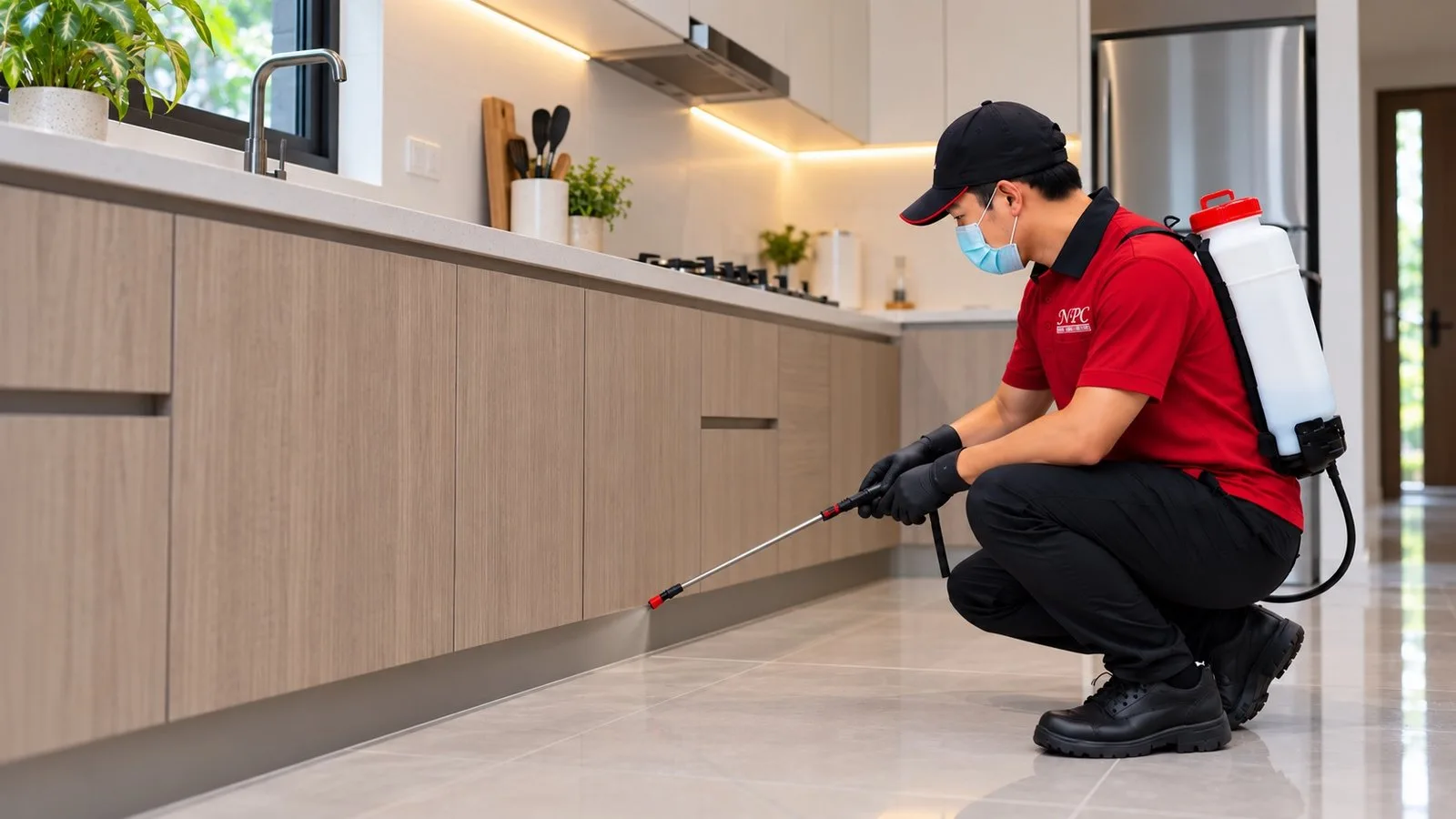
Here is a short look at NPC’s licensed team at work.

2UV Zapper vs Glue Board: Which Is Safer for Food Premises?
Quick Answer: A UV glue board trap is safer near food. It holds each fly whole on a sticky board. A zapper kills flies on an electric grid, which can throw fly parts and fine particles into the air. For kitchens and prep rooms, choose a glue board commercial fly trap in Malaysia and keep zappers away from food.
| Trap type | How it catches | Contamination risk near food | Catch easy to count? | Best place for it |
|---|---|---|---|---|
| UV zapper (electric grid) | Kills flies on a high-voltage grid | Yes: fly parts and fine particles can scatter | Hard: parts fall into a tray or away | Bin rooms, loading bays and outdoor areas away from food |
| UV glue board trap | Holds flies on a sticky board | Very low: flies stay whole on the board | Easy: count and log the board each visit | Kitchens, prep rooms, stores and service areas |
| Decorative UV glue board trap | Glue board hidden inside a wall-light style cover | Very low | Easy, but only the technician sees the board | Dining areas, lobbies and hotel corridors |
| Sticky ribbon or tube (no light) | Flies land on the glue while resting | Very low | Easy while the glue is fresh | Short-term use; glue can drip near heat |
Source: Insects 2021 review of alternative house fly controls; Current Microbiology 2000 study of electrocuting insect traps. Compiled by NPC Pest Control, 2026.
The zapper problem is backed by research. A 2000 Current Microbiology study loaded flies with bacteria and a virus, then let an electric trap kill them. The electrocuted flies released some of those germs into the room. Flies with germs on their bodies released far more than flies that had eaten them.
A 2021 review in the journal Insects notes that this finding led to glue board traps for food areas. It also points out that zappers are still seen mounted above food counters in many countries.
- Glue board units. Quiet, no fragments, and the board doubles as a record of what was caught.
- Zappers. Fine for a bin room or covered loading bay where no food is exposed.
Flies are not the only pest that follows sugar and food spills. If you also see trails near the same spots, our guide on why DIY ant baits fail explains the next step.
3Does the Size and Design of a Fly Trap Matter?
Quick Answer: Yes. In an indoor test, an open-front commercial trap caught about twice as many house flies as a small home-style unit when each was tested alone. Side by side, the small trap caught almost nothing. A proper commercial fly trap in Malaysia should have a wide, open face and enough UV output for the room.
| Trap and test | Share of released flies caught after 4 hours (%) |
|---|---|
| Open-front commercial trap, tested alone (house flies) | 76% |
| Small home-style trap, tested alone (house flies) | 38% |
| Open-front commercial trap, side by side (house flies) | 66% |
| Small home-style trap, side by side (house flies) | 3% |
| Open-front commercial trap, tested alone (stable flies) | 18% |
| Small home-style trap, tested alone (stable flies) | 3% |
Source: Journal of Insect Science 2019, indoor trials at the USDA-ARS laboratory in Gainesville, Florida (50 flies released per test). Laboratory results, not field results.
These results come from a 2019 Journal of Insect Science study at a US Department of Agriculture laboratory. Researchers released 50 flies per test and counted catches.
What the numbers mean for buyers:
- Home units fall short in trade kitchens. They can work in a small room on their own, but they lose badly when a stronger light competes with them.
- Stable flies are harder to catch. No trap replaces cleaning and screening.
- Tube type matters. The Insects review found that standard black light tubes, which peak around 360 to 370 nm, attract more flies than black light blue tubes because they are brighter.
Board colour matters too. The same review reports field studies where black glue boards caught up to 50% fewer flies than white ones.
4Where Should You Place a Fly Trap in a Restaurant?
Quick Answer: Place fly traps low, near doors and delivery points, out of sight from the street, and never directly above food or prep tables. Research found floor-level traps caught more flies than traps mounted 2 metres high. Placement often matters more than which commercial fly trap in Malaysia you buy.
| Zone | UV zapper | UV glue board | Decorative glue board | Sticky ribbon |
|---|---|---|---|---|
| Kitchen and food prep | Avoid | Good fit | Possible | Avoid |
| Dining area or lobby | Avoid | Possible | Good fit | Avoid |
| Dry store and chiller room | Avoid | Good fit | Possible | Possible |
| Back door and loading bay | Possible | Good fit | Avoid | Possible |
| Bin room and refuse area | Good fit | Good fit | Avoid | Possible |
| Factory production line | Avoid | Good fit | Avoid | Avoid |
Source: illustrative guide by NPC Pest Control, 2026, based on the contamination and placement findings in the Insects 2021 review. Not a measured survey.
The best evidence comes from a 2021 Journal of Economic Entomology study in a large supermarket. Over eight weeks, 18 UV traps caught 3,626 house flies. Wall traps mounted 2 metres high caught significantly fewer flies than larger traps placed on the floor, and the bakery and deli had the busiest traps.
Placement rules we follow on site:
- Low beats high. Mount the trap as low as foot traffic and cleaning allow. The Insects review cites poultry-house trials where low traps caught 10 times more flies than traps set 1.5 metres up.
- Inside the doorway, at low level. A light mounted above a doorway can draw flies toward the door and in.
- Hidden from outside. A glow visible from the back lane invites flies in.
- Away from food. Keep traps clear of prep tables, sinks and open food.
Restaurants face the most scrutiny here. Our pest control for restaurants page shows how traps fit into a monthly programme.
5How Many Fly Traps Does a Commercial Premises Need?
Quick Answer: There is no fixed legal number. A small café may need two or three traps, while a central kitchen or factory may need one per entry point and one per food zone. The right count for any commercial fly trap in Malaysia setup comes from a site survey that maps doors, bins and food areas.
We size a premises by counting its entry points and food zones, since floor area alone says little about where flies get in.
| Premises | Typical starting layout | Watch point |
|---|---|---|
| Small café or kiosk | One glue board unit in the kitchen, one decorative unit front of house | Main door left open during trading |
| Shophouse restaurant | Units at the back door, kitchen, dry store and dining area | Back lane bins and shared drains |
| Hotel | Units in each kitchen, loading bay, refuse room and restaurant | Buffet lines and service corridors |
| Food factory | One unit per dock door and per production zone, logged on a site map | Audit trail for each trap |
Treat these as starting points only. Hotels, factories and clinics usually need traps numbered on a map with a catch log for audits. Our guide to commercial pest control contracts explains how to write that into a service agreement.
Planning traps for a new outlet or kitchen?
Send us your floor plan and we will mark each trap position and explain why it goes there. Get a trap layout for your premises →
6How Often Should Fly Trap Tubes and Glue Boards Be Changed?
Quick Answer: Change the glue board every month, or sooner if it fills up or gets dusty. Replace UV tubes about every six months, even if they still glow. Without that upkeep, a commercial fly trap in Malaysia slowly becomes a wall light.
| Upkeep routine | Month 0 | Month 3 | Month 6 | Month 9 | Month 12 |
|---|---|---|---|---|---|
| Boards monthly, tubes every 6 months | 100 | 95 | 100 | 95 | 100 |
| Boards monthly, tubes never changed | 100 | 90 | 80 | 70 | 60 |
| Boards and tubes left alone | 100 | 45 | 25 | 15 | 10 |
Source: illustrative model by NPC Pest Control, 2026, reflecting the monthly board and six-monthly tube service described in the Insects 2021 review. Index values, not measured counts.
The Insects review describes the standard commercial routine: a monthly visit to replace glue boards, check the unit works and clean it, with tubes replaced every six months. The chart above is an illustrative model of what happens when that routine slips.
Signs your traps are overdue:
- A full or grey board. Dust and dead insects cover the glue, so new flies land and walk off.
- No date on the board. Nobody can tell when it was last changed.
- Flies around the trap, few on the board. Often a sign of old tubes or a poor spot.
- Heat or grease nearby. Glue near fryers and ovens softens and loses grip faster.
Heat, humidity and grease wear boards faster, so busy kitchens may need changes every two weeks.
7Should You Buy or Rent a Commercial Fly Trap?
Quick Answer: Buying suits small outlets with staff who will change boards and tubes on schedule. Renting through a service contract suits busy kitchens, hotels and factories, because the provider supplies boards and tubes, logs every catch and fixes faults. Either way, price a commercial fly trap in Malaysia as unit plus upkeep over a year.
| Question | Buy outright | Rent with a service contract |
|---|---|---|
| Who changes boards and tubes? | Your staff | The technician, on each visit |
| Catch records for audits | Only if you keep them | Logged and reported each visit |
| Faulty unit | You arrange the repair | Usually swapped under the contract |
| Best for | Kiosks, small cafés, offices | Restaurants, hotels, clinics, food factories |
The hidden cost is missed upkeep. An unserviced unit catches little and gives a false sense of cover.
Food businesses also have a legal duty. Regulation 16 of the Food Hygiene Regulations 2009 requires food premises to be kept free from pests, and dated catch records help show inspectors you are on top of it. For what else a service visit should cover, see our guide to pest control services in Malaysia.
8What Should a Fly Trap Service Visit Include?
Quick Answer: A proper fly trap service visit changes the glue board, counts and records the catch by trap number, checks the tubes and wiring, cleans the unit, and reports any rise in catches with the likely source. A commercial fly trap in Malaysia is only as useful as the records it produces.
How to check your fly trap service each month
Use these steps to confirm you are getting what you pay for.
- Check the board date. Each board should carry the date it went in and the trap number.
- Read the catch count. Ask for the number of flies per trap, not just “normal” or “high”.
- Compare with last month. A trap whose count keeps rising points to a nearby breeding source.
- Confirm tube changes. The report should show when tubes were last replaced.
- Act on the findings. Fix the bin, drain or door the report points to, then check the next count.
Flies often share drains and bin areas with cockroaches. If a technician sees both, our cockroach control service can treat them in the same programme.
9Conclusion: The Trap Is Only Half the Job
Quick Answer: The right commercial fly trap in Malaysia is a glue board unit near food, placed low near entry points, with boards changed monthly and tubes every six months. Add catch records and act on them, and your traps become an early warning system for the whole premises.
Flies in Malaysian food premises are a year-round problem. Match each commercial fly trap in Malaysia to its zone, place it where flies travel, keep it serviced, and use the catch to fix the source.
For more ways to protect your premises, visit the NPC Pest Control homepage or browse all our pest control services.
10Frequently Asked Questions
1. Are UV fly zappers allowed in Malaysian restaurant kitchens?
The Food Hygiene Regulations 2009 do not name trap types, but food must be protected from contamination. Zappers can scatter fly parts, so glue board traps are the safer choice near food.
2. How often should the glue board in a fly trap be changed?
Every month in most food premises, or sooner if it fills up or gets dusty.
3. How long do UV fly trap tubes last?
Commercial service usually replaces UV tubes every six months, even if they still light up.
4. Can I put a fly trap above the food prep table?
No. Keep traps clear of prep tables, sinks and open food. Place them near entry points instead.
5. Does NPC Pest Control install and service commercial fly traps?
Yes. NPC Pest Control is a licensed operator in Puchong with over 15 years of work across the Klang Valley, and inspections are free. Call 03-8061 1875 or 016-335 9799, Monday to Saturday, 9am to 6pm.
Get the right trap in the right spot
We will walk your premises for free, mark where each fly trap should go and show you which flies are getting in and from where.
Book a free fly trap survey →