
Last updated: 9 October 2026
Pest control is the part of a food safety audit that most often turns into a finding. This guide is for QA and plant managers at food factories, exporters, slaughterhouses and cold stores in KL and Selangor. It shows how to make pest records stand up to an auditor:
- The audit file. The seven records auditors expect, and the gap each one usually has.
- Trend analysis. How to turn catch numbers into proof that pests are under control.
- Site differences. Where exporters, slaughterhouses and cold stores need extra care.
- Your contractor. How to check the operator whose name is on every report.
Running a restaurant or shop rather than a plant? Our guide to the pest control certificate for food business licence renewal covers the council side.
Audit date already on the calendar?
Tell us your standard and site size, and we will plan pest visits and reports around your audit cycle. See our factory pest control service →
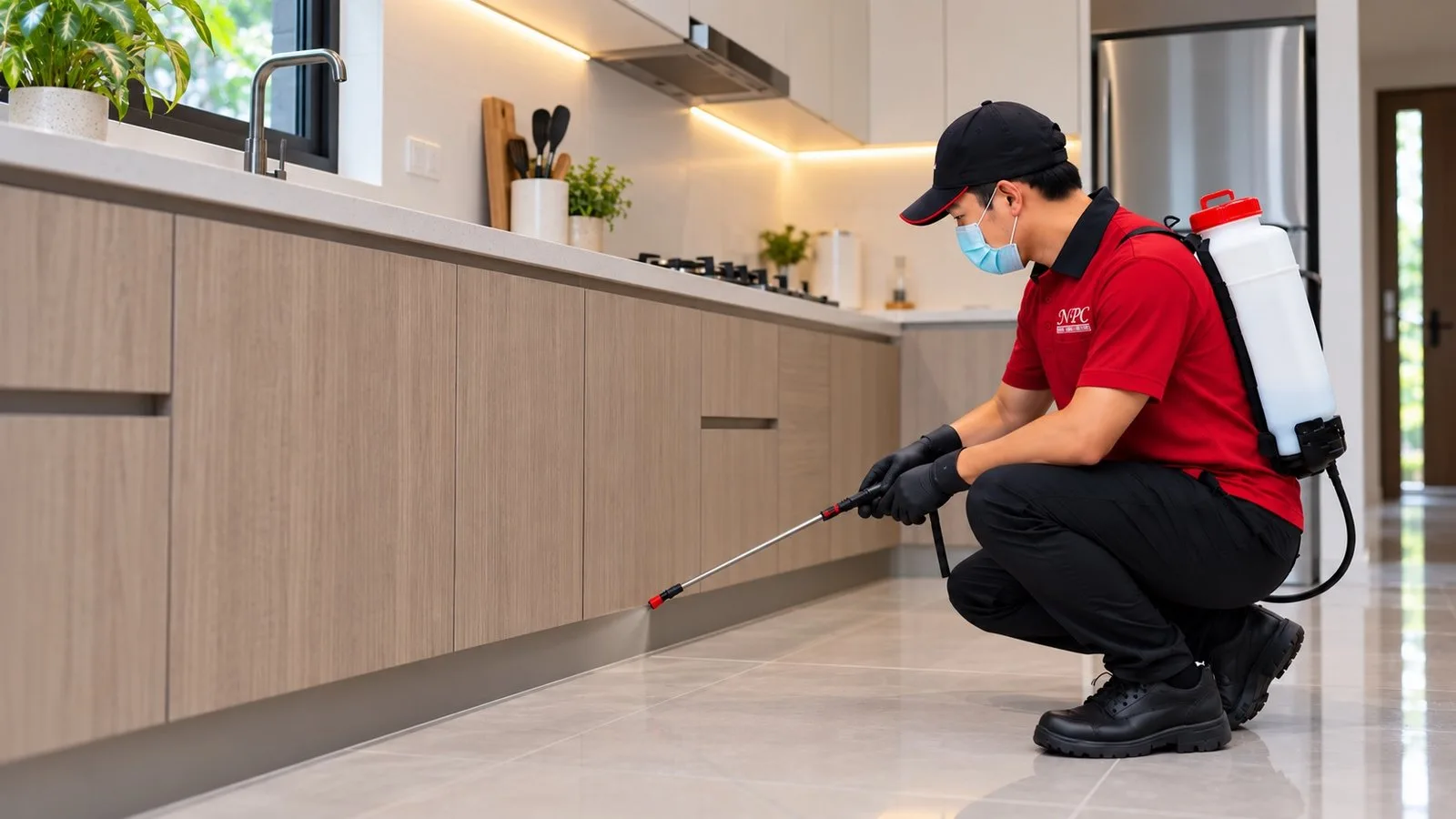
Here is a short look at NPC’s team at work.

1What Does Certification for Pest Control Mean in a Food Factory?
Quick Answer: In a food factory, certification for pest control means the documented pest programme an auditor reviews for HACCP, GMP, MeSTI or a buyer’s audit. There is no separate pest certificate. The auditor wants evidence that a licensed operator runs the programme and that the plant acts on what it finds.
QA teams search for certification for pest control because a certification body or an export buyer has asked for it. What the auditor wants is not a framed paper but a working system.
The system rests on three things:
- A legal base. The Food Hygiene Regulations 2009 (regulation 16) require food premises to be kept free of pests, with prompt action when pests appear.
- A prerequisite programme. Standards Malaysia describes GMP under MS 1514 as one of the prerequisite programmes for a HACCP system, and pest control sits inside it.
- Records. Each visit, catch and corrective action written down, so an auditor can trace it.
The work behind the records is the same work our factory pest control team does on site. The paperwork simply proves it happened.
2Why Do Auditors Look So Hard at Pest Control?
Quick Answer: Auditors look hard at pest control because it is one of the most common failures they find. In a 2025 Irish audit of 24 food storage businesses, 58% had a pest control non-compliance. In Penang, 68.9% of food premises closures from January to April 2026 were linked to pest issues.
| Finding | Share (bar scale 0–100%) |
|---|---|
| Penang food premises closures linked to pest issues (122 of 177, Jan–Apr 2026) | 68.9% |
| Irish food storage businesses with a pest control non-compliance (14 of 24, 2025) | 58% |
| Irish food businesses where auditors found rodent droppings (8 of 24, 2025) | 33% |
| Irish audit non-compliances linked to pest control (2025) | Almost 30% |
Source: Penang Health Department figures reported by Bernama, 16 June 2026; Food Safety Authority of Ireland, Audit of Ambient Storage and Distribution Food Business Operations, October 2025. Penang figures cover food premises, not only factories.
The Food Safety Authority of Ireland’s 2025 audit report named pest control as the most common area of non-compliance. Rodent droppings turned up in a third of the sites. Closer to home, the Penang Health Department inspected 4,069 food premises and ordered 177 to close, 122 of them over pest control issues, as reported by Bernama.
Why pests weigh so heavily in an audit:
- They are visible. One dropping on a pallet is hard evidence an auditor can photograph.
- They test the system. A sighting with no record behind it shows the programme is not working.
Under section 11 of the Food Act 1983, serious contamination can lead to a closure order of up to 14 days. A routine commercial pest control contract is far cheaper than a lost production fortnight.
3What Pest Control Records Does a HACCP or GMP Audit Need?
Quick Answer: For certification for pest control, a HACCP or GMP audit usually expects seven records. Three set up the programme: the contract and scope, the operator’s licence copy and the approved pesticide list with labels and safety data sheets. Four prove it works: service reports, a device map, trend analysis and a corrective action log.
| Record | What it proves | Who produces it | Common audit gap |
|---|---|---|---|
| Service contract and scope | Pests covered, areas, visit frequency and response time | Contractor, agreed with QA | Scope stops at the building, so the perimeter and bin area are missing |
| Operator licence copy | The firm may legally do pest control for hire | Contractor | Copy on file has expired; licences run for two years |
| Service reports (Form H) | Date, product, active ingredient, concentration, method, area and quantity | Contractor, every visit | Trade name only, no active ingredient or quantity |
| Approved pesticide list with labels and SDS | Every product used is suitable for use near food | Contractor, checked by QA | A product appears on a report but not on the list |
| Monitoring device map | Numbered bait stations, traps and insect light traps | Contractor and QA | Map not updated after a line or wall moved |
| Catch records and trend analysis | Activity per device over time, against an alert level | Contractor, reviewed by QA | Numbers recorded every visit but never trended |
| Corrective action log | What was found, what was done and when it was closed | QA with the contractor | Actions left open with no date or owner |
Source: planning guide by NPC Pest Control, 2026, built on Form H of the Pesticides (Pest Control Operator) Rules 2004 and regulation 16 of the Food Hygiene Regulations 2009. Your standard and certification body set the final list.
The service reports carry legal weight. Under the Pesticides (Pest Control Operator) Rules 2004, the operator must give you a written report in the set format, Form H, after each job. It names the active ingredient, trade name, concentration, method, area treated and quantity used. The operator keeps its own copy for two years.
The certification for pest control gaps auditors raise most often are small ones. A report lists a trade name but no active ingredient. A bait station on the map no longer exists on the floor. A sighting is logged but the corrective action has no closing date.
Monitoring devices need care too. Our guide to the commercial fly trap options for food sites explains insect light traps, and our rat proofing guide covers the gaps rodents use to get in.
4How Do You Show Pest Trend Analysis to an Auditor?
Quick Answer: Show pest trend analysis by plotting catches per device or area over time against an alert level, then marking what you did when a line crossed it. Auditors want to see that someone reviews the numbers, spots rises early and closes them with dated corrective action.
| Measure | Jan | Mar | May | Jul | Sep | Nov |
|---|---|---|---|---|---|---|
| Bait stations showing rodent activity (%) | 4% | 6% | 14% | 8% | 5% | 4% |
| Insect light trap catch, as % of alert level | 40% | 55% | 110% | 70% | 50% | 45% |
Source: illustrative scenario by NPC Pest Control, 2026, for a Klang Valley food plant. The May spike follows nearby construction; corrective action closed it by July. Not measured data.
Most plants already collect the data at every visit: stations with rodent activity and insect light trap catches. The weak point is the review. Numbers sit in reports and nobody looks at them together.
A simple trend review covers four points:
- The alert level. Agree with your contractor what count triggers action, for each device type.
- The review rhythm. Plot the numbers monthly or quarterly and sign the review.
- The cause. Note what drove a spike, such as nearby construction or an open door.
- The close-out. Record the corrective action and show the numbers falling back.
In the example above, the May spike crossed the light trap alert level. A dated action and a fall by July is exactly the story an auditor wants to read. For flying insects in particular, our fly control guide for food businesses covers causes behind a rising catch.
Catch numbers piling up with no trend report?
We can review a year of your service reports and set alert levels with your QA team. Talk to us about factory pest monitoring →
5Which Pest Records Matter Most for Exporters, Slaughterhouses and Cold Storage?
Quick Answer: The core file is the same for every food site, but the focus shifts. Exporters face buyer audits that probe stored-product insects. Slaughterhouses and poultry plants watch rodents, flies and birds closely. Cold stores focus on rodents at loading bays and dock doors. Your risk assessment should show the reason for each priority.
| Site type | Rodents | Flying insects | Stored-product insects | Cockroaches | Birds |
|---|---|---|---|---|---|
| Food processing plant (HACCP or GMP) | Focus | Focus | Watch | Focus | Watch |
| Exporter facing buyer audits | Focus | Focus | Focus | Watch | Watch |
| Slaughterhouse or poultry plant | Focus | Focus | Low | Watch | Focus |
| Cold storage | Focus | Low | Watch | Watch | Watch |
| Dry goods warehouse | Focus | Watch | Focus | Watch | Focus |
Source: planning guide by NPC Pest Control, 2026, for food sites in Kuala Lumpur and Selangor. Your own risk assessment decides the real priorities. Not measured data.
Certification for pest control at an export plant often goes beyond local rules, because the buyer’s own standard applies. Expect questions on insect checks of incoming raw material and protection of finished goods.
Points to add for each site type:
- Exporters. Records for incoming goods inspection and for any fumigation of stock or containers.
- Slaughterhouses and poultry plants. Bird proofing checks and fly monitoring near waste and lairage areas.
- Cold storage. Rodent stations at dock doors and dated checks of door seals and strip curtains.
Logistics and storage sites have their own page: see our pest control for transport and logistics. If a plant extension is being built, the termite paperwork follows a different path, covered in our guide to certificate pest control for anti-termite warranties at handover.
6How to Prepare Pest Control Records Before a Certification Audit
Quick Answer: Prepare at least a month ahead. Check the contract scope and licence copy, and match every service report to the device map. Then run a trend review, close open corrective actions, walk the site with your contractor and put the file in audit order. Your certification for pest control then reads as one clear story.
How to prepare your pest control records for a HACCP or GMP audit
Work through these steps in the weeks before the audit.
- Check the contract scope. Make sure it covers every building, the perimeter, waste areas and any new line.
- Update the licence copy. Confirm the operator’s licence is current on the public register.
- Match reports to the device map. Every station on the map should appear in recent reports, and the reverse.
- Run the trend review. Plot catches since the last audit and sign the review.
- Close corrective actions. Add a date and owner to each open item, or record why it stays open.
- Walk the site with your contractor. Look for gaps, spills and harbourage before the auditor does.
- Put the file in audit order. Contract, licence, pesticide list, map, reports, trends, actions.
The audit itself follows set stages. Under the Standards Malaysia scheme for GMP to MS 1514, the stage 2 audit normally comes within six months of stage 1. Surveillance audits then review earlier non-conformities and any changes. A pest finding left open at one audit is the first thing checked at the next.
| Audit stage | What the pest file must show |
|---|---|
| Stage 1 | A written pest programme, contract and device map are in place |
| Stage 2 | The programme works on site, with reports and actions to prove it |
| Surveillance | Earlier findings are closed and trends are reviewed |
7How Do You Check Your Pest Control Contractor’s Credentials?
Quick Answer: Check that the company holds a current pest control operator licence on the Department of Agriculture’s public register. Then confirm its technicians hold applicator licences and every product on its list is registered for the use. Keep the evidence in your certification for pest control file and recheck before each audit.
Licensing pest control operators is a safeguard the World Health Organization recommends wherever pesticides are used near people and food. In Malaysia, the Department of Agriculture’s register of pest control operator licences is open to the public, and a licence is valid for two years.
Questions to ask before you sign:
- Licence. Is the licence in the same company name as the invoices?
- Reports. Will every visit produce a Form H report with the active ingredient and quantity?
- Trends. Who prepares the trend analysis, and how often?
Our guide to the pest control license in Malaysia shows how to search the register. For a broader shortlist, use our checklist for choosing a pest control company.
Changing contractors before your next audit?
We can inspect your plant and quote a service plan with Form H reports and trend reviews built in. Compare our commercial pest control plans →
8Conclusion: Build the Pest File All Year
Quick Answer: Certification for pest control in a food factory comes down to a pest file that tells one clear story. A licensed operator, a report for every visit, a current device map, reviewed trends and closed actions are what HACCP, GMP and export auditors want to see.
Keep the file current every month and the audit becomes a review, not a scramble. Restaurants and central kitchens face a lighter version of the same checks, covered in our guide to pest control for restaurants and audits.
Visit the NPC Pest Control homepage for our full range of pest control services.
9Frequently Asked Questions
1. Is there a separate government certificate for pest control in a food factory?
No single certificate covers it. For HACCP, GMP or MeSTI audits, certification for pest control means a file of records from a licensed operator: contract, licence copy, service reports, pesticide list, device map, trend analysis and corrective actions. The auditor judges that file, not one document.
2. How long should a food factory keep pest control records?
The licensed operator must keep each Form H report for two years under the Pesticides (Pest Control Operator) Rules 2004. Most plants keep their own copies at least back to the last full certification audit. Check your standard and your certification body for a longer period.
3. Can our own staff handle pest control for a HACCP plant?
Trained staff can check monitoring devices and log what they find. Anyone doing pest control for hire must hold a licence under the Pesticides Act 1974, so outside treatments need a licensed operator. Keep the staff training records in the same pest file.
4. Can NPC Pest Control help a food factory prepare for an audit?
Yes. NPC Pest Control is a licensed pest control operator in Puchong with over 15 years of work across Kuala Lumpur and Selangor. Share your audit date and standard, and ask us to set out the visit plan and reports in the quotation. Call 03-8061 1875 or 016-335 9799, Monday to Saturday, 9am to 6pm.
Audit coming up and the pest file still thin?
Tell us your audit date, standard and site layout. We will inspect the plant and quote a service plan with the records your auditor expects.
Book a free factory inspection →