Last updated: 9 October 2026
Termite treatment on a new building is buried under concrete within days. Months later, at handover, the only proof it happened is paper. This guide is for developers, main contractors, consultants and project managers in KL and Selangor who need the termite documents ready before practical completion:
- The handover pack. The six documents behind a warranty certificate, and the gap each one usually has.
- The roles. Who issues, checks and keeps each paper.
- The warranty period. What published test data says about how long protection lasts.
- After handover. What voids the cover, and how to check the certificate before you accept it.
The treatment itself has its own guide. Our builder’s guide to pre-construction anti-termite treatment covers the site stages and timing, so this article stays on the paperwork.
Pouring footings or a slab soon?
Tell us your pour dates and we will plan the termite treatment stages around them. See our termite control service →
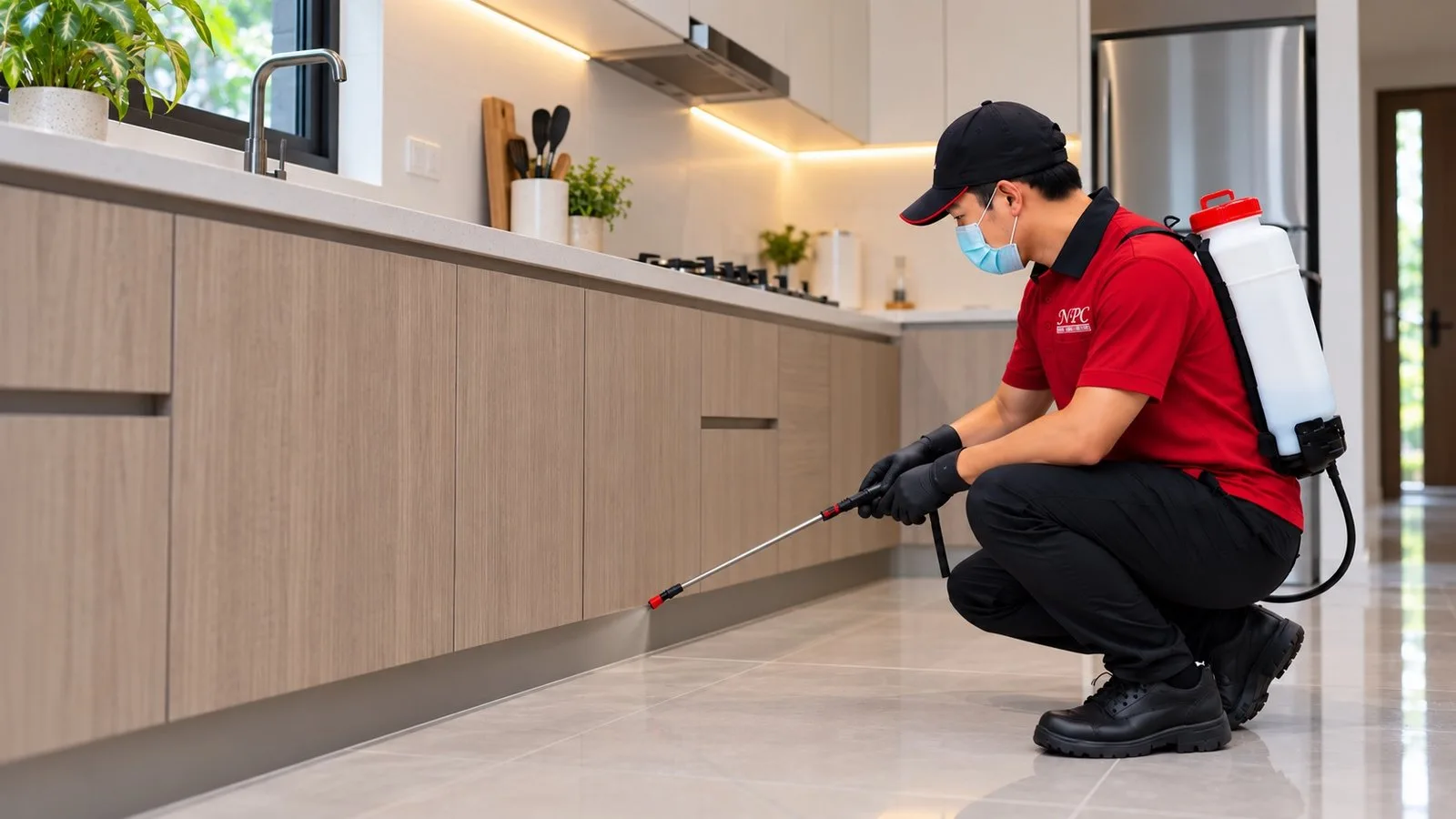
Here is a short look at NPC’s team at work.

1What Is Certificate Pest Control on a Building Project?
Quick Answer: Certificate pest control on a building project is anti-termite treatment that ends with a signed warranty or guarantee certificate. The certificate names the project, the area treated, the product and the period of cover, and promises inspection and re-treatment if termites get in under stated conditions.
Contractors search for certificate pest control because the certificate is what the consultant asks for at the end of the job. Once the slab is poured, it is the only part of the treatment anyone can still see.
A useful certificate states:
- The project and the treated area. Lot, block and every slab covered, including porches and aprons.
- The product and method. The termiticide used and whether it was a soil barrier, a sheet barrier or baiting.
- The period and start date. How long the cover runs and from which day.
- The conditions. Inspections the owner must book and changes that end the cover.
The protection behind the paper comes from the termite control work on site. Our guide to anti-termite soil treatment explains how the soil barrier under a slab works.
2Why Can a Missing Termite Certificate Delay Handover?
Quick Answer: When the specification lists the termite guarantee as a handover document, the consultant or superintending officer can wait for it before issuing the CPC. That pushes back handover, the start of the defects liability period and payments linked to completion. Your contract clause decides the exact rule.
| Site approach | 12 weeks before | 8 weeks before | 4 weeks before | 2 weeks before | CPC inspection |
|---|---|---|---|---|---|
| Paperwork chased at the end | 10% | 15% | 25% | 45% | 70% |
| Reports collected after each stage | 40% | 55% | 70% | 85% | 95% |
| Pack checked against the spec at award | 50% | 65% | 85% | 100% | 100% |
Source: illustrative scenario by NPC Pest Control, 2026, for Klang Valley building projects. Index values, not measured data.
Sites that chase termite paperwork in the final fortnight reach the CPC inspection with gaps. Sites that collect a report after each stage arrive nearly complete.
What a late certificate can hold up:
- The CPC itself. An incomplete handover pack gives the certifier a reason to wait.
- Retention and progress claims. Payments tied to practical completion move back with it.
- Vacant possession. Buyers and tenants wait longer for keys.
Food premises face a similar paper trail. Our guide to the pest control certificate for food business licence renewal covers that side.
3What Documents Make Up an Anti-Termite Handover Pack?
Quick Answer: A complete anti-termite handover pack usually has six parts: a report for each treatment stage, the product label and safety data sheet, a copy of the operator’s licence, a treated area plan, the signed warranty certificate and an inspection schedule. Your specification may add or drop items.
| Document | Issued by | When | What it proves | Common gap |
|---|---|---|---|---|
| Stage treatment reports | Licensed operator | On the day of each stage | Product, dose, area and date for footings, slab and perimeter | Slab report missing because nobody asked on pour day |
| Product label and safety data sheet | Licensed operator | Before work starts | The termiticide is registered for termite use in Malaysia | Product changed on site without telling the consultant |
| Operator licence copy | Licensed operator | Before work starts | The firm may legally do pest control for hire | Expired copy carried over from an older project |
| Treated area plan | Operator, checked by the consultant | After the last stage | Which blocks, slabs and extensions are covered | Car porch or later slab left off the plan |
| Warranty or guarantee certificate | Termite specialist | Before practical completion | Period, start date, area, conditions and claim contact | Start date tied to treatment day, not handover |
| Inspection schedule | Termite specialist | With the certificate | When yearly checks fall due and who books them | Owner never told, so the cover lapses |
Source: planning guide by NPC Pest Control, 2026, built on the written report required under the Pesticides (Pest Control Operator) Rules 2004. Your contract and specification decide the final list.
The stage reports matter most because the law requires them. Under the Pesticides (Pest Control Operator) Rules 2004, the operator must give the customer a written report in the set format, Form H, naming the product, its concentration, the method, the area treated and the amount used. The operator keeps its own copy for two years.
The certificate rests on those reports. If the slab report is missing, nobody can prove the soil under the concrete was treated. The certificate pest control specialists sign then has nothing behind it, and a careful consultant will notice.
Buildings treated after completion follow a different route. Our owner’s guide to post-construction anti-termite treatment covers what that quotation and warranty should include.
Specification asks for a termite guarantee?
Send us the clause and your concrete schedule, and we will quote the treatment stages and documents to match. Plan termite protection for your project →
4Who Signs and Who Holds the Anti-Termite Warranty?
Quick Answer: The termite specialist signs the warranty. The main contractor collects and submits it, the consultant or superintending officer checks it against the specification, and the developer or employer receives it at handover. After that, the owner or strata body keeps it and books the yearly inspections that keep it valid.
| Document or task | Termite specialist | Main contractor | Consultant or SO | Developer or employer | Owner or JMB/MC |
|---|---|---|---|---|---|
| Stage treatment reports | Issues | Checks | Checks | Keeps | – |
| Treated area plan | Issues | Checks | Checks | Keeps | – |
| Warranty or guarantee certificate | Issues | Checks | Checks | Keeps | Keeps |
| Inspection schedule | Issues | – | – | Keeps | Keeps |
| Claims during the warranty | Issues | Checks | – | Keeps | Checks |
Source: planning guide by NPC Pest Control, 2026, reflecting a typical split on Malaysian building projects. Your contract decides the actual roles. Not measured data.
Most warranty disputes start with unclear roles. The contractor assumes the developer will pass the certificate on. A buyer finds termites in year three and learns the cover lapsed after an inspection nobody told them about.
Points to settle in the certificate pest control quotation:
- Whose name is on the certificate. The employer, the developer or each purchaser.
- Whether it can be transferred. Buyers of completed units need the benefit to pass to them.
- Who books inspections. Name one party in the handover documents.
Factories and warehouses follow the same chain on a larger scale. Our commercial pest control page covers ongoing service for those sites, and food plants should read our guide to certification for pest control audit records.
5How Do You Get the Termite Certificate Ready Before CPC?
Quick Answer: Start at contract award. Read the specification clause, agree the certificate terms at quotation, book treatment around the pour dates, collect a signed report after each stage and submit the full pack well before the CPC inspection. Certificate pest control planned this way rarely holds up handover.
How to prepare an anti-termite handover pack before practical completion
Work through these steps from contract award to handover.
- Read the specification clause. Note the warranty period, its start date, the format and any named standard.
- Agree the certificate terms at quotation. Ask the specialist to confirm the period, conditions and inspection schedule in writing.
- Share the concrete schedule. Send footing and slab pour dates so each treatment stage is booked ahead.
- Collect a report after every stage. File each one with the date, location and product details.
- Mark the treated area plan. Include porches, aprons and any slab added after the main pour.
- Submit the pack early. Give the consultant the full set a few weeks before the CPC inspection.
- Brief the owner. Hand over the inspection schedule and the specialist’s contact with the certificate.
Some specifications name the Malaysian Standard MS 1849:2005, the code of practice for protecting buildings against subterranean termites. If yours does, ask the specialist to confirm the treatment follows it. For budgeting, see our anti-termite treatment cost guide.
6How Long Does an Anti-Termite Warranty Usually Last?
Quick Answer: The contract and the specialist’s quotation set the warranty period. Published benchmarks give context: the US EPA’s suggested standard for soil termiticides is five years of complete resistance, based on yearly reinspection. A longer warranty usually depends on inspections and top-up treatment.
| Benchmark or product | Years of protection (bar scale, max 21) |
|---|---|
| US EPA suggested standard for wood treatments | 2 to under 5 years of complete resistance, with yearly reinspection |
| US EPA suggested standard for soil termiticides | 5 years of complete resistance, based on yearly reinspection |
| Lambda-cyhalothrin treated polyethylene sheet under slabs | Effective for more than 5.5 years |
| Chlordane at 1/8% (withdrawn in 1987) | 100% effective for 21 years |
Source: Oi, Insects, 2022, review of termite control and efficacy testing in the United States. US test data; Malaysian heat, rain and site disturbance can shorten these periods.
These figures come from a 2022 review in the journal Insects, which puts the global cost of termites at about USD 40 billion a year, with subterranean termites causing about 80% of it. Chlordane lasted longest but was withdrawn in 1987 over health concerns.
What this means for your certificate pest control terms:
- Check what the period covers. A long warranty is only as good as its conditions, especially yearly inspections.
- Check the start date. Cover that starts on treatment day can lose months before handover.
- Check the remedy. Look for inspection and re-treatment, and whether damage repair is excluded.
Malaysian heat and rain can shorten these periods. Our guide to termite control services in Malaysia explains how protection is kept up.
7What Can Void an Anti-Termite Warranty After Handover?
Quick Answer: Most anti-termite warranties are voided by changes the owner makes or by missed inspections. Renovations that cut the slab, extensions on untreated soil, landscaping over the treated band and skipped yearly checks are the usual causes. A good certificate lists these exclusions in plain words.
Common exclusions to explain to buyers at handover:
- Renovation and extensions. Kitchens, car porches and back extensions often sit on soil that was never treated.
- Disturbed perimeter soil. New drains, planter boxes and paving can break the treated band along the walls.
- Missed inspections. Many warranties need a yearly check booked by the owner.
- Treatment by another firm. Spraying by a different company can end the original specialist’s cover.
For condos and gated schemes, ask the JMB or MC to add one line to its renovation guidelines: any work that breaks the slab or the perimeter soil needs a termite check first. That single rule protects the certificate pest control cover for every owner in the scheme.
When the barrier lapses, owners usually move to a termite baiting system. A yearly termite inspection is what keeps most warranties alive.
Handing over units soon?
We can inspect the treated buildings and give owners a clear yearly inspection plan before keys change hands. Arrange a termite inspection before handover →
8How Do You Check a Termite Warranty Certificate Before Accepting It?
Quick Answer: Before accepting certificate pest control work at handover, check five things: the operator holds a valid licence, the product is registered for termite use, the stage reports match the certificate, the project details and treated area are correct, and the period, start date and conditions match your specification. Fix any mismatch first.
Anyone doing pest control for hire must be licensed under the Pesticides Act 1974. The Department of Agriculture’s register of pest control operator licences is public, so the licence check takes two minutes.
| Check | What to look for |
|---|---|
| Licence | Active operator licence in the company’s name on the register |
| Product | Same termiticide on the reports, label and certificate |
| Area | Every block and slab shown on the treated area plan |
| Dates | Stage dates match the pour records |
| Terms | Period, start date and conditions match the specification |
Our guide to the pest control license in Malaysia walks through the register step by step. To shortlist a specialist in the first place, use our checks for choosing a termite control company.
9Conclusion: Plan the Paperwork With the Pour Dates
Quick Answer: In certificate pest control, the warranty is a small document that can hold up a large handover. Read the specification at award, collect a report after every treatment stage, check the certificate against the contract, and give the owner the inspection schedule that keeps the cover alive.
Plan the paperwork with the concrete schedule and the termite guarantee rarely becomes the last open item at CPC. For owners weighing protection later, our guide on whether your home needs anti-termite treatment is a good next read.
Visit the NPC Pest Control homepage for our full range of pest control services.
10Frequently Asked Questions
1. Is an anti-termite warranty certificate required for practical completion?
Only if your contract or specification asks for it, and many do. Where certificate pest control is on the handover document list, the certifier can wait for the guarantee before issuing the CPC. Check the clause at contract award.
2. Who keeps the original anti-termite warranty certificate?
The developer or employer usually receives it at handover and passes it to the owner, or to the JMB or MC for strata buildings. Whoever holds it should also book the yearly inspections that keep the cover valid.
3. How long is an anti-termite warranty?
For certificate pest control, the contract and the specialist’s quotation set the period, so read both. For context, the US EPA’s suggested standard for soil termiticides is five years of complete resistance, based on yearly reinspection.
4. Can NPC Pest Control help with anti-termite work on a building project?
Yes. NPC Pest Control is a licensed pest control operator in Puchong with over 15 years of work across Kuala Lumpur and Selangor. Send us your specification clause and pour dates and ask us to set out the reports and warranty terms in the quotation. Call 03-8061 1875 or 016-335 9799, Monday to Saturday, 9am to 6pm.
CPC coming up and the termite paperwork still open?
Send us your specification clause and pour schedule. We will plan the treatment stages and quote the documents your handover needs.
Get a project anti-termite quote →