Last updated: 23 September 2026
This guide on pest control for restaurant Malaysia operators in KL and Selangor covers:
- The rules. The exact pest clauses an inspector checks under Malaysian food law.
- The stakes. What happens when a restaurant fails on pests.
- The paperwork. Which records each type of audit asks for.
- The countdown. A seven-day plan to get your kitchen audit-ready.
For the service itself, see our restaurant pest control service page.
Want to know where your kitchen stands?
We walk your kitchen, store and back lane, then tell you what an inspector would flag. See how our restaurant pest programme works →
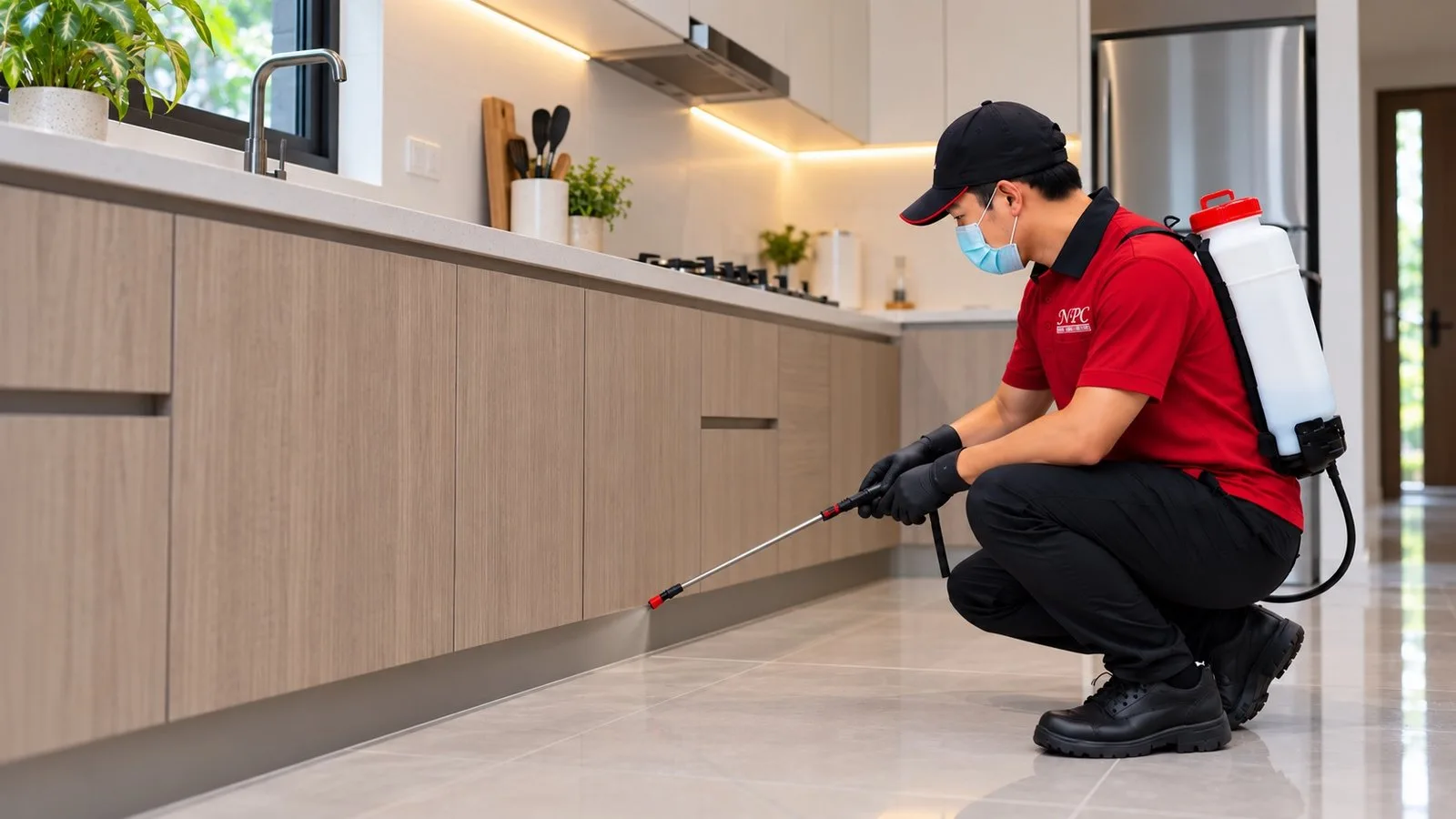
Here is a short look at NPC’s team at work.

1What Do Health Inspectors Check for Pests in a Restaurant?
Quick Answer: Inspectors check the pest clauses of the Food Hygiene Regulations 2009. The premises must be pest-free at all times, with quick action and food-safe treatment when pests appear. They also look for clutter, open bins, gaps, doors left open and untrapped drains. Pest control for restaurant Malaysia premises has to cover the building as well as the pests.
| Food Hygiene Regulations 2009 | What the rule requires | What an officer will look at |
|---|---|---|
| Reg 8(1)(c) | A notice at the entrance saying no animals allowed | Is the sign up and readable? |
| Reg 15(2) | No boxes, tins, bottles or rubbish that let pests hide | Cartons, clutter behind fridges |
| Reg 15(3) | Cleaning at least once a day, removing food residue and dirt | Grease under fryers, crumbs along wall edges |
| Reg 16(1) | Premises kept free from any pest at all times | Insects, droppings, gnaw marks |
| Reg 16(2) | Act at once when pests are found, and stop them coming back | Proof of the treatment and the follow-up |
| Reg 16(3) | Treatment must use a suitable agent and not threaten food safety | Chemical smell, spray residue near open food |
| Reg 17 | Refuse removed quickly, in closable bins, stored away from pests | Open bins, overflowing back-lane refuse |
| Reg 19(2) and 23 | Wall-floor joints sealed and coved; doors smooth and self-closing | Gaps at skirting, back door propped open |
| Reg 29 | Kitchen drains smooth and fitted with a food trap | Missing grates, food waste in drains |
Source: compiled by NPC Pest Control, 2026, from the Food Hygiene Regulations 2009 (Food Act 1983), regulations 8, 15, 16, 17, 19, 23 and 29. The third column is our summary of common inspection points.
The table draws on the Food Hygiene Regulations 2009, made under the Food Act 1983. Regulation 16 is the core rule. It says the owner or occupier must keep the premises free from any pest at all times, act at once when pests appear, and prevent them coming back.
Most of the rules are about the building: clutter, bins, doors, joints and drains. That is why a spray alone rarely passes. The officer checks whether the kitchen gives pests food, water and shelter. Our guide to cockroach control for KL homes and eateries explains how shared drains and back lanes feed an outlet’s pest problem.
2What Happens if a Restaurant Fails on Pests?
Quick Answer: A failed pest check can lead to a compound, a fine, or a closure order. Under section 11 of the Food Act 1983, an officer can close a food premises for up to 14 days if it is unhygienic and likely to be hazardous to health. Strong pest control for restaurant Malaysia outlets is cheaper than one lost fortnight.
The legal risks come from two laws:
- Closure order. Section 11 of the Food Act 1983 lets an authorised officer order closure for up to 14 days. Ignoring it can mean up to five years in jail, a fine, or both.
- Fines under the regulations. Most offences in the Food Hygiene Regulations 2009 carry a fine of up to RM10,000 or up to two years in jail, and many can be settled by compound.
- Public exposure. A closure notice on your shutter spreads fast on social media.
Pests near food carry real health risks, as three Malaysian studies show.
| Malaysian finding | Share affected |
|---|---|
| People with allergic rhinitis sensitised to cockroach allergens (Kelantan, 110 patients) | 39.1% |
| Rats at four KL wet markets carrying leptospirosis antibodies (144 rats) | 34.7% |
| Filth flies at Klang wet markets carrying Salmonella (90 flies) | 17.8% |
Source: Expert Review of Clinical Immunology, 2025 (Kelantan); Journal of Vector Borne Diseases, 2024 (Kuala Lumpur); International Journal of Food Microbiology, 2023 (Klang). Bar length scaled for readability.
A 2024 Journal of Vector Borne Diseases study found 34.7% of 144 rats caught at four KL wet markets had leptospirosis antibodies. A 2023 International Journal of Food Microbiology study found Salmonella on 17.8% of 90 filth flies at Klang wet markets. And a 2025 study from Kelantan found 39.1% of 110 allergic rhinitis patients were sensitised to cockroach allergens.
Rats are the most serious kitchen finding. Our guide to the signs you need professional rat control shows what to look for.
3How Often Should a Restaurant Have Pest Control?
Quick Answer: The law sets no fixed number of visits. It requires the premises to be free of pests at all times, so frequency depends on risk. Most restaurants need a monthly service, while busy or 24-hour kitchens need visits every two weeks. That is the practical standard for pest control for restaurant Malaysia outlets.
Many websites say the Ministry of Health requires monthly treatment, yet the regulation names no frequency. It sets an outcome, “free from any pest”, and leaves you to prove it. Landlords and auditors may set their own minimum.
| Type of outlet | Typical service interval | Why |
|---|---|---|
| Café or bakery with light cooking | Monthly | Sugar and flour draw ants and cockroaches |
| Full-service restaurant | Monthly | Grease, drains and daily deliveries |
| 24-hour mamak or busy kopitiam | Every two weeks | No quiet hours for cleaning or treatment |
| Central kitchen or caterer | Every two weeks, plus monitoring | Food safety audits expect trend records |
| Shoplot with a back lane and rat history | Every two weeks until clear, then monthly | Rats return from shared drains and refuse |
These intervals come from our work with food outlets in KL and Selangor. Our commercial pest control contract guide shows how to write the schedule and reporting into a contract.
4Which Restaurant Audits Ask for Pest Control Records?
Quick Answer: Almost every audit asks for proof. Health officers focus on what they see. Halal, HACCP, MeSTI, ISO 22000, mall and franchise audits expect a pest file with service reports, a station map, a sighting log, trend reviews and a chemical list. Complete records make pest control for restaurant Malaysia audits far easier.
| Type of audit | Service reports | Bait and monitor map | Pest sighting log | Trend review | Chemical list and labels |
|---|---|---|---|---|---|
| Health or council inspection | Often asked | Sometimes | Sometimes | Rarely | If they see spraying |
| Halal certification audit | Expected | Expected | Often asked | Sometimes | Expected |
| HACCP, MeSTI or ISO 22000 audit | Expected | Expected | Expected | Expected | Expected |
| Mall or landlord audit | Expected | Often asked | Sometimes | Rarely | Sometimes |
| Franchise or head-office audit | Expected | Expected | Expected | Often asked | Often asked |
| Delivery platform or client check | Sometimes | Rarely | Rarely | Rarely | Rarely |
Source: illustrative guide by NPC Pest Control, 2026, based on audits its food clients in Kuala Lumpur and Selangor have faced. Darker shading = more likely to be asked. Always check your own auditor’s checklist.
The guide above is illustrative, based on audits our food clients have faced. Ask your auditor for their checklist in advance. Some patterns hold:
- Food safety system audits want the most. HACCP, MeSTI and ISO 22000 auditors check that findings lead to actions.
- Halal auditors look closely at chemicals. Keep labels and safety data sheets on file.
- Health officers look at the kitchen first. Live pests or droppings decide the outcome.
Flies are a common finding in open kitchens. Our guide to choosing a commercial fly trap covers placement and the service log auditors check.
Getting ready for halal, HACCP or a mall audit?
We set up the station map, service reports and trend review your auditor will ask for, and keep them current every visit. Get your restaurant audit-ready with us →
5What Should Be in a Restaurant Pest Control Logbook?
Quick Answer: A good logbook holds the contract, the operator’s licence copy and every service report. Add a map of bait stations and monitors, a staff sighting log, a chemical list with labels, and a record of each fix. Together these prove your pest control for restaurant Malaysia programme works between visits.
Your pest control company should supply most of this. Under the Pesticides (Pest Control Operator) Rules 2004, a licensed operator must give you a written report after each job. It shows the active ingredient, trade name, concentration, method, area treated and quantity used.
The logbook, section by section:
- Contract and licence. Scope, schedule and the operator’s licence copy.
- Service reports. One signed report per visit, in date order.
- Station map. A floor plan with every station, trap and fly unit numbered.
- Sighting log. Staff record any pest seen, with date, time and place.
- Chemical list. Every product used, with label and safety data sheet.
- Corrective actions. What was fixed, by whom and when.
Keep the file in the kitchen office, with a scanned copy online. Our guide to what pest control services include explains what a full visit covers.
6How Does Monitoring Data Help a Restaurant Pass an Audit?
Quick Answer: Monitoring traps count pests zone by zone each month. When the counts are tracked, a rising trend shows up before customers or inspectors see a pest. Auditors of food safety systems often ask for this trend review, and it turns pest control for restaurant Malaysia work from reactive spraying into planned prevention.
| Kitchen zone | Month 1 | Month 2 | Month 3 | Month 4 | Month 5 | Month 6 |
|---|---|---|---|---|---|---|
| Back door and refuse area | 4 | 7 | 12 | 5 | 2 | 1 |
| Dishwashing and drains | 3 | 3 | 4 | 3 | 2 | 2 |
| Dry store | 1 | 1 | 2 | 1 | 1 | 0 |
| Dining area | 0 | 0 | 1 | 0 | 0 | 0 |
Source: illustrative example by NPC Pest Control, 2026. Catches per month on glue-board monitors; a door seal and refuse-area fix were made after month 3. Not measured data.
In this illustrative example, back-door catches climbed for three months. A new door sweep and moving the bins fixed it by month five.
A useful trend review shows counts by zone, a trigger level that sets off an extra visit, and the action taken with its result. Good pest control for restaurant Malaysia kitchens reviews this every visit.
If counts stay high near drains and dishwashing, read our guide to gel and spray cockroach treatment to see which method fits a working kitchen.
7How Do You Prepare Your Restaurant for a Pest Audit?
Quick Answer: Start a week before. Book your routine service early, deep clean the hotspots, clear clutter, check doors and drains, update the logbook and brief your staff. Avoid spraying the day before, since smell and residue near food count against you. This is how pest control for restaurant Malaysia teams stay ready.
How to prepare your restaurant for a pest audit
Follow these steps in the week before an audit.
- Book the routine service early. Aim for five to seven days before, so any treatment has settled.
- Deep clean the hotspots. Under fryers, behind fridges, drains and wall edges.
- Clear the clutter. Remove cartons, empty tins and unused equipment.
- Check doors and gaps. Make sure back doors self-close and fix any gaps at pipes and skirting.
- Check drains and bins. Replace missing grates and make sure every bin has a working lid.
- Update the logbook. File the latest report, sighting log and fix records in order.
- Brief your staff. Tell them where the file is and who answers the auditor’s questions.
Gaps are the step most kitchens skip. Our guide to rat proofing entry points gives the gap sizes and materials to use.
8What Mistakes Make Restaurants Fail a Pest Audit?
Quick Answer: The most common mistakes are spraying just before the visit, storing stock in cardboard, leaving back doors open, letting drains and bins overflow, and keeping no written records. Each one breaks a clause in the regulations. Avoiding them is the simplest part of pest control for restaurant Malaysia compliance.
Mistakes we see most often:
- The last-minute spray. Regulation 16(3) requires treatment that does not threaten food safety. A strong smell near open food raises questions.
- Cardboard in the store. Cockroaches lay eggs in carton folds. Move stock into sealed plastic tubs.
- A propped back door. Fit a door sweep and a strip curtain instead.
- Night-time refuse. Bags left out overnight draw rats.
- No records. An empty file gives the auditor nothing to check.
The right provider helps with most of these. Our guide to choosing a cockroach control company lists the questions to ask. Many owners also book sanitisation and disinfection once a pest problem is cleared.
9Conclusion: Pass the Audit Before the Auditor Arrives
Quick Answer: Pest control for restaurant Malaysia operators comes down to three habits. Set the service schedule by risk, keep the kitchen free of clutter, gaps and open drains, and keep a pest file that proves the work. Do those every month and any audit becomes routine.
For more, visit the NPC Pest Control homepage, browse all our pest control services, or read about our commercial pest control for other food businesses.
10Frequently Asked Questions
1. How often should a restaurant in Malaysia have pest control?
The law sets no number of visits, only that premises stay pest-free. Most restaurants need a monthly service; busy or 24-hour kitchens may need visits every two weeks.
2. Can a restaurant be closed because of cockroaches or rats?
Yes. Under section 11 of the Food Act 1983, an authorised officer can order a food premises closed for up to 14 days if it fails hygiene requirements and is likely to be hazardous to health.
3. Should we spray the kitchen just before an inspection?
No. A last-minute spray leaves smell and residue near food. Book your routine service a week before, then clean.
4. What pest control documents should a restaurant keep?
The contract, licence copy, service reports, station map, sighting log, chemical list and records of fixes.
5. Does NPC Pest Control serve restaurants in KL and Selangor?
Yes. NPC Pest Control is a licensed pest control company in Puchong with over 15 years of work across Kuala Lumpur and Selangor, and site inspections are free. Call 03-8061 1875 or 016-335 9799, Monday to Saturday, 9am to 6pm.
Audit coming up and not sure your pest file is ready?
Tell us your outlet type and audit date. We will inspect your kitchen for free, fix what we find and set up the records your auditor expects.
Book a free kitchen inspection →