Last updated: 22 September 2026
1What Is Post Construction Anti Termite Treatment?
Quick Answer: Post construction anti termite treatment is any termite protection added after a building is finished and occupied. Because the floor slab is already cast, the soil cannot be sprayed in the open. Instead, the chemical is injected through the floor and along outside walls, or bait stations are set up around the building to wipe out colonies.
NPC Pest Control is a licensed operator based in Puchong, with over 15 years of termite work in Kuala Lumpur and Selangor. Most of the termite jobs we quote are post-construction ones, for owners who moved in years ago and now wonder whether their home is still protected.
The stakes are real. A review in Insects (2022) puts the global cost of termites at about USD 40 billion a year, with subterranean termites causing about 80% of it. Those are the ground-dwelling termites that attack Klang Valley homes.
The two treatment windows differ in who pays and when:
- Pre-construction. The developer or contractor sprays the soil before the slab is poured. Our pre-construction anti-termite guide covers that job.
- Post-construction. The owner arranges protection for a finished building. This guide is written for you, the owner, and explains when to book, what to choose and what to demand in writing.
For the full service from inspection to warranty, see our termite control services page.
Moved in years ago and not sure you are still covered?
We inspect for free and tell you whether your home needs a barrier, bait or nothing yet. See how our termite treatment works →
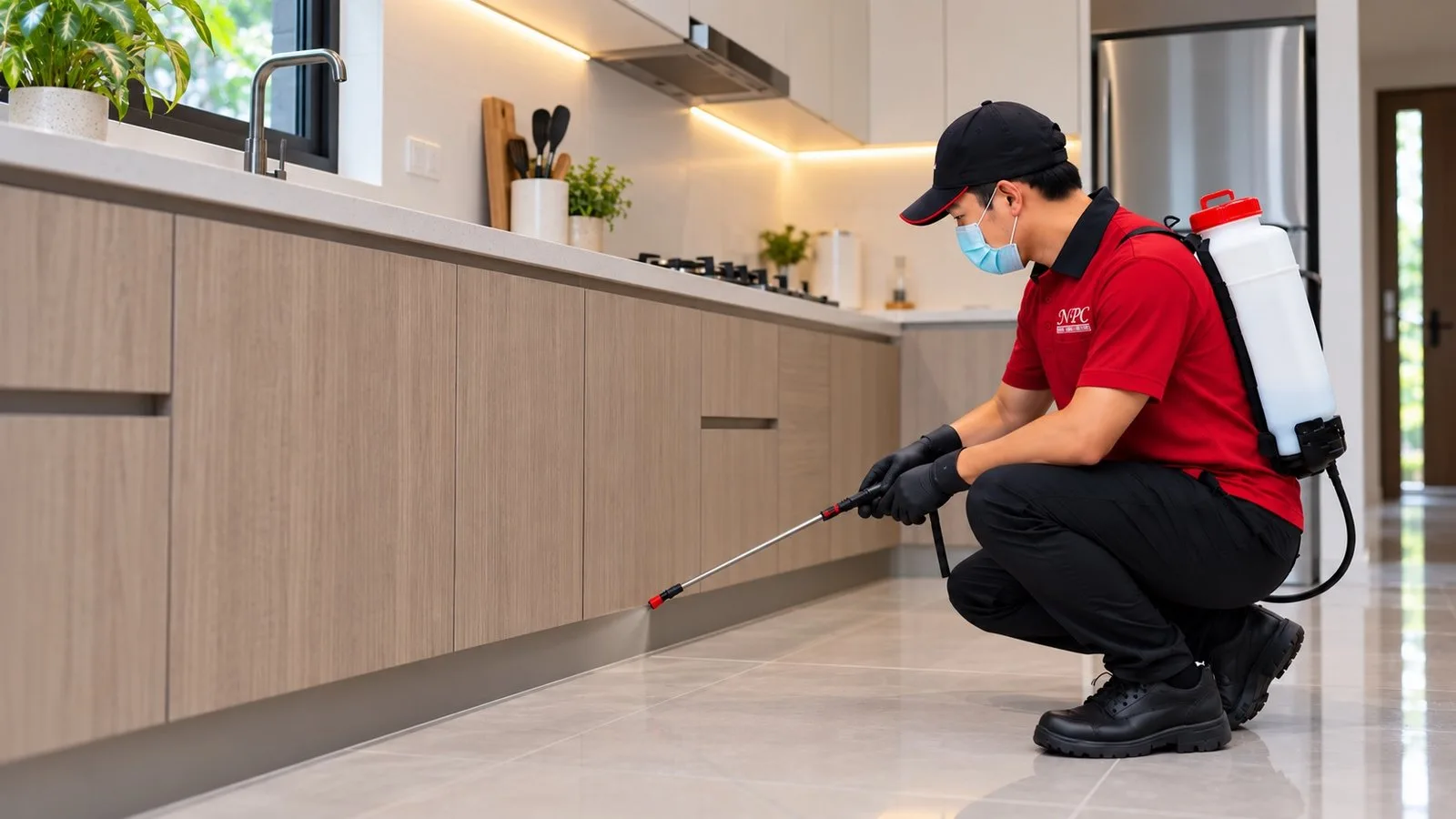
Here is a short look at NPC’s licensed team at work.

2When Should You Book Post-Construction Termite Treatment?
Quick Answer: Book post construction anti termite treatment when your existing protection has lapsed or been broken. Common triggers are the end of the developer’s warranty on the original soil treatment and buying an older landed home with no records. Renovation that cut through the floor counts too, as do the weeks after a live colony is eliminated.
Most owners never see the pre-construction treatment, so they assume it lasts forever. It does not. The chemical breaks down in warm, wet soil, and every renovation cuts new paths through it. The heat map shows how urgent each trigger is for different buildings.
| Trigger | New landed home | Resale landed home | Condo unit | Shop lot or factory |
|---|---|---|---|---|
| Developer’s warranty ending | Book now | Inspect first | Rarely needed | Book now |
| Just bought, no treatment records | Rarely needed | Book now | Inspect first | Book now |
| Floor hacked or extension built | Book now | Book now | Rarely needed | Book now |
| Live colony just eliminated | Book now | Book now | Inspect first | Book now |
| Termites found next door | Inspect first | Book now | Rarely needed | Inspect first |
| Flooding or long-term leak | Inspect first | Inspect first | Rarely needed | Inspect first |
Source: illustrative guide from NPC Pest Control site surveys, Klang Valley, 2026.
Resale buyers carry the biggest blind spot. A sub-sale house rarely comes with the original treatment certificate, and the seller may have renovated twice since. Treat the purchase itself as a trigger: book an inspection before or soon after the keys change hands. Our guide to termite inspection services in Malaysia explains what that visit covers.
3Who Arranges Post-Construction Treatment: Developer, Owner or Management?
Quick Answer: For a finished landed home, the owner arranges and pays for post construction anti termite treatment. The developer is only answerable for defects reported during the defect liability period in your sale and purchase agreement. In a condo or strata building, the management body handles the ground floor and common areas, while owners treat inside their own units.
| Property | Who usually arranges it |
|---|---|
| New landed home, within the defect period | Report termites to the developer in writing first |
| Landed home after the defect period, or resale | The owner |
| Condo or apartment unit | Management body for common areas; owner for the unit |
| Rented house | Usually the landlord, as set out in the tenancy agreement |
If you find termites in a new house, photograph the damage and notify the developer before treating, so you do not lose the right to claim. After that period, post-construction anti-termite treatment is the owner’s call. Not every home needs it straight away, and our guide on whether your home needs anti-termite treatment gives a simple risk check.
4Which Post-Construction Method Fits Your Building?
Quick Answer: The main post construction anti termite treatment methods are a drill-and-inject soil barrier, an outdoor trench treatment, a baiting system, and spot treatment of infested timber. A barrier keeps termites out, bait kills the colony, and spot treatment only handles what you can see. Many landed homes end up with bait first, then a barrier.
| Method | What it does | Disruption | Best for |
|---|---|---|---|
| Drill-and-inject soil barrier | Blocks termites entering through the floor and walls | Holes drilled along walls, then sealed | Homes with no live termites that need long-term protection |
| Outdoor trench treatment | Treats soil along the outside of external walls | Digging along the building’s edge | Garden-facing walls, porches and planter boxes |
| Baiting system | Eliminates the whole colony | In-ground or above-ground stations; little mess | Live termites already feeding in the home |
| Bait first, then barrier | Removes the colony, then keeps the next one out | Two stages over several weeks | Landed homes with an active attack and high local risk |
| Spot treatment of timber | Kills termites in the treated wood only | Minimal; spray or foam into timber | Small, isolated finds; condo units |
Source: NPC Pest Control field practice, Kuala Lumpur and Selangor, 2026.
The right mix depends on one question: are termites already inside?
- No live termites. A soil barrier gives long-term protection. Our guide to how anti-termite soil treatment works explains the drilling, the products and what happens on the day.
- Live termites in timber. Start with a termite baiting system. A barrier around an active colony can trap termites inside the house or just push them to another wall.
- Condo or upper-floor unit. The unit does not touch the ground, so spot treatment or bait is usually enough; the building’s management handles the ground floor.
Shop lots, factories and warehouses have long perimeters and many service entries, so our commercial pest control team plans those as separate site programmes.
5How Long Should Post-Construction Protection Last?
Quick Answer: A good post construction anti termite treatment should protect for about five years with yearly checks. That matches the benchmark regulators use. Guidance from the United States Environmental Protection Agency, summarised in Insects (2022), asks soil termiticides to show five years of complete protection, with annual reinspection.
| Treatment or benchmark | Years of complete protection | Years |
|---|---|---|
| Chlordane at 1/8% in field tests (since phased out) | 21 | |
| Insecticide-treated plastic sheet under slab (more than) | 5.5 | |
| Soil termiticide performance standard (US EPA) | 5 | |
| Wood treatment minimum, with yearly reinspection (US EPA) | 2 |
Source: compiled by NPC Pest Control from the review of termite control and product registration requirements, Insects (2022).
Malaysia has no equivalent published test standard for homeowners to check, so the United States benchmark is a useful yardstick. The same review notes that wood treatments only need to show two to five years of protection, and only with an annual reinspection. It also reports that at the United States Forest Service test sites, only bifenthrin and fipronil could claim full protection for five years or more at the common use rate.
The chlordane figure shows why older owners remember “treat once, forget it”. That long-lasting organochlorine has since been phased out worldwide. Today’s products break down faster, which is safer for families but means protection has an end date.
In Malaysia every termiticide must be registered under the Pesticides Act 1974 (Act 149). Ask your operator which registered active ingredient they will use, and how long they will stand behind it.
6What Should the Quotation and Warranty Include?
Quick Answer: A proper quotation for post construction anti termite treatment names the method, the registered active ingredient, the treated areas, the number of holes or stations, and the warranty period. The warranty should state what it covers, how often inspections happen, and which events, such as renovation or skipped visits, would void it.
Vague quotes are the main source of disputes we hear about. Ask for these items in writing before any drilling starts:
- Method and product. Barrier, bait or both, with the active ingredient named.
- Scope. Which walls, pipe entries, porches and planter boxes are included, and which are not.
- Warranty length and terms. Whether it covers free retreatment only, or repair of new damage too.
- Inspection schedule. How many visits per year are included, and the price after the warranty ends.
- Licence details. The operator’s licence under the Pesticides Act, so you know who is accountable.
How to keep your post-construction termite warranty valid
Most voided warranties come from owner actions, not product failure. These steps protect your cover.
- Keep every document. Store the quotation, treatment report and warranty card together, and pass them to the buyer if you sell.
- Tell the operator before renovating. Hacking floors or extending the kitchen breaks the barrier, so arrange retreatment of the disturbed area.
- Keep the inspection dates. Book each yearly visit on time; a skipped visit is a common reason for voided cover.
- Fix leaks near walls. Repair dripping pipes and blocked drains, which keep soil damp and attract termites.
- Keep timber off the ground. Move stored wood, cardboard and old furniture away from outside walls.
- Report signs early. Call the operator as soon as you see mud tubes, wings or hollow timber.
Comparing termite quotations?
Send us your situation and we will quote after a free inspection, with the product, scope and warranty in writing. Request a written termite quotation →
7What Happens to Protection Over a Home’s First Ten Years?
Quick Answer: Protection from the developer’s soil treatment fades over the first few years, and post construction anti termite treatment resets it. In our illustrative model, homes that add a post-construction barrier at year five and keep yearly inspections stay well protected. Homes relying only on the original treatment lose most of their cover by year ten.
| Owner’s approach | Year 0 | Year 2 | Year 4 | Year 6 | Year 8 | Year 10 |
|---|---|---|---|---|---|---|
| Developer’s treatment only | 100 | 85 | 55 | 42 | 30 | 20 |
| Barrier at year 5, no inspections | 100 | 85 | 55 | 95 | 80 | 66 |
| Barrier at year 5, yearly inspections | 100 | 85 | 55 | 97 | 94 | 91 |
Source: illustrative model by NPC Pest Control, 2026 (100 = complete fresh protection; kitchen renovation assumed in year 4). Not a laboratory measurement.
This model compares three owners of the same terrace house. It is not a lab measurement, but it reflects the pattern we see on site in Kuala Lumpur and Selangor:
- Relied on the developer’s treatment only. Protection slides year after year, and a kitchen renovation at year four speeds the loss.
- Added a barrier at year five, then forgot about it. Protection jumps back up, but slowly fades again with no checks.
- Added a barrier at year five with yearly inspections. Weak spots are found and retreated early, so protection stays high.
The difference between the second and third owner is simply the yearly visit. Our guide to what to expect from termite control services explains what each visit involves.
8How Much Does Post Construction Anti Termite Treatment Cost?
Quick Answer: For an intermediate terrace house in the Klang Valley, a drill-and-inject barrier usually costs RM2,500 to RM4,500 and a baiting programme RM1,200 to RM3,500, as indicative market ranges. Spot treatment starts from about RM300. Corner lots, semi-Ds and bungalows cost more because they have longer walls and more soil to treat.
| Post-construction option | Indicative range, terrace house |
|---|---|
| Spot treatment of infested timber | RM300 to RM800 |
| Baiting until the colony is eliminated | RM1,200 to RM3,500 |
| Drill-and-inject soil barrier | RM2,500 to RM4,500 |
| Yearly monitoring after treatment | RM800 to RM2,000 a year |
These are Klang Valley market ranges, not a price list. The final figure depends on wall length, floor finish, the product used and whether a colony is active. Our anti-termite treatment cost guide breaks the drivers down by home type.
9Conclusion: Treat the House You Own, Not the One the Developer Built
Quick Answer: Post construction anti termite treatment is how owners restore protection once the original soil treatment fades or is broken. Book it at handover expiry, after a resale purchase, after renovation or after a colony is cleared. Choose bait for live termites and a barrier for prevention, and demand five years of written cover with yearly checks.
Start with an inspection rather than a product. It tells you whether termites are active and which mix fits your building. For a wider view of home pest care, read what a pest control service includes, visit the NPC Pest Control homepage, or see our termite treatment service.
10Frequently Asked Questions
1. What is the difference between pre- and post-construction anti-termite treatment?
Pre-construction treatment is sprayed onto open soil before the floor slab is cast, and is arranged by the developer. Post-construction treatment protects a finished building, usually by injecting termiticide through drilled holes or by setting up bait stations, and is arranged by the owner.
2. How do I know if my house already has anti-termite treatment?
Ask the developer or the previous owner for the treatment certificate or warranty card. If there is no record, or the cover has expired, book a termite inspection. It shows whether termites are active and whether a new barrier is worth adding.
3. Can post-construction treatment be done while we live in the house?
Yes. Most families stay in the home. Keep children and pets out of the rooms being drilled and injected until the floor is dry, and cover food and utensils in the kitchen. Baiting causes even less disruption.
4. Does renovation void my termite warranty?
It often does for the disturbed areas, because hacking floors or building an extension cuts through the treated soil. Tell your operator before work starts and arrange retreatment of those areas once the renovation is finished.
5. Does NPC Pest Control do post-construction termite treatment in Kuala Lumpur and Selangor?
Yes. NPC Pest Control provides post construction anti termite treatment across Kuala Lumpur and Selangor, after a free inspection that decides between bait, a soil barrier or both. Call 03-8061 1875, Monday to Saturday from 9am to 6pm, or request an inspection through our contact page.
Is your home still protected from termites?
NPC Pest Control inspects for free, checks for live colonies and recommends bait, a soil barrier or both, with the warranty in writing.
Book my free termite inspection →